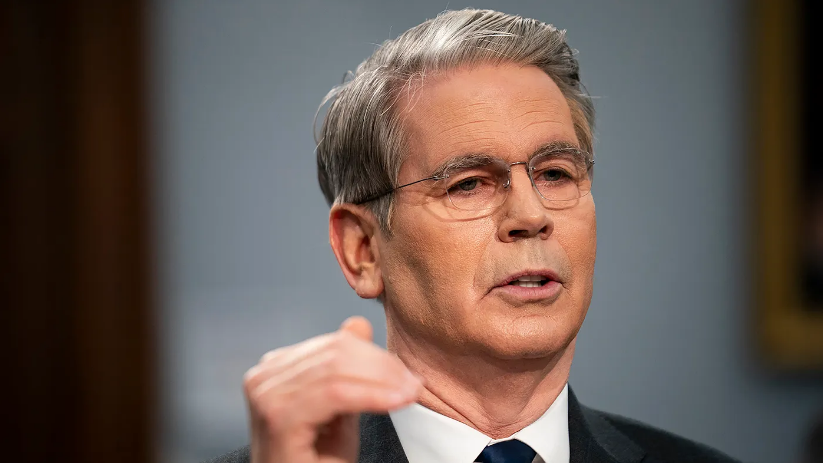
US Treasury Secretary Scott Bessent has revealed that he recently left his Washington, D.C., residence and relocated to an American military base following security concerns linked to threats from Iran. Despite the situation, the senior Trump administration official insists he is not afraid, arguing that American military personnel and even President Donald Trump face similar threats.
In an interview with CNBC, Bessent was asked about the reported threats against him and his decision to move away from his home. He responded by questioning why he should be frightened when American service members stationed in the Persian Gulf and the president himself are also regularly targeted by death threats.
“Why should I be afraid when our military personnel in the Persian Gulf and President (Donald) Trump are constantly receiving death threats? ” Bessent said.
His comments come amid growing concerns within the US government about potential Iranian operations targeting American officials and citizens. Tehran has denied allegations that it is plotting attacks against people on American soil, but warnings from US intelligence officials have raised questions about the potential security risks.
Bessent described Iran’s current behavior as that of “like a dangerous, trapped animal,” suggesting that the country could become increasingly unpredictable under pressure. He also explained that his relocation was not simply a personal decision, but followed guidance from the US Secret Service.
However, the security situation was not the only factor Bessent mentioned when explaining why he left his home. He also pointed to a photograph of his Georgetown property published by The Wall Street Journal in January 2025.
The image, which showed his residence from the air, was something Bessent strongly criticized, arguing that making such information public could create unnecessary risks for government officials and their families.
“Very irresponsible and dangerous, and things like this need to stop,” he said.
The warning, reviewed by Reuters, suggested that the potential threats were no longer merely theoretical and had progressed to a more serious level. Although Iran has rejected accusations of planning attacks inside the United States, the intelligence assessment underscores the security challenges facing American authorities.
Bessent has also become one of the central figures in Washington’s economic campaign against Tehran. Since August, he has been leading a US sanctions and economic pressure initiative known as Operation Economic Outcast, which aims to force Iran to end its attacks on commercial shipping and reopen the strategically important Strait of Hormuz.
The Strait of Hormuz has remained largely closed since the United States and Israel launched strikes against Iran on February 28. Its closure has become a central issue in the confrontation, with Washington seeking to increase economic pressure on Tehran while attempting to restore access to the vital maritime route.
As part of that strategy, the Trump administration has combined its sanctions campaign with a US naval blockade targeting Iranian ports. The economic measures have extended beyond Iran itself, reaching financial institutions and companies in other parts of the Middle East that help facilitate transactions involving the country.
Among the targets have been branches of banks operating across the region, as well as other financial services firms accused of supporting transactions connected to Iran.
The measures are intended to restrict Tehran’s access to international financial networks and increase the economic consequences of its actions.