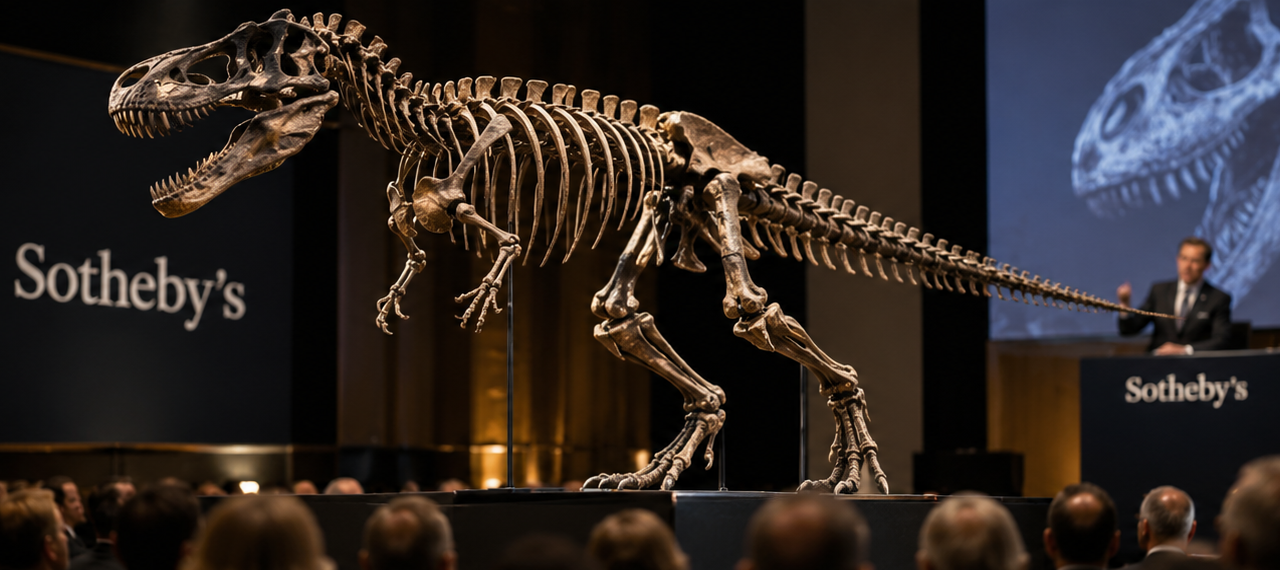
A rare skeleton of a Nanotyrannus, a smaller relative of Tyrannosaurus rex, has sold for $47.3 million at an auction in New York, making it one of the most expensive dinosaur fossils ever sold.
The skeleton, named “Jodi” after the person who discovered the remains in 2019, was sold at Sotheby’s on Tuesday following an intense bidding battle that lasted 12 minutes. Six bidders competed online and over the telephone before the winning offer was ultimately submitted by phone, according to the auction house.
The final price far exceeded Sotheby’s original estimate of $6 million to $9 million. The auction house described the result as making Jodi “the second most valuable dinosaur ever sold at auction.”
The identity of the buyer has not yet been publicly disclosed.
Jodi was discovered in 2019 by Jodi Pierson on her private land in the Hell Creek Formation in Garfield County, Montana, near the town of Jordan.
The skeleton was later presented at a Manhattan auction earlier this month, attracting considerable attention from collectors and dinosaur enthusiasts ahead of the sale.
According to Sotheby’s, the skeleton measures 19.6 feet from nose to tail and stands approximately 9.6 feet tall when mounted. It contains approximately 191 fossilized bone elements, making it a substantial specimen of the prehistoric predator.
Sotheby’s described Jodi as one of only “three substantial Nanotyrannus skeletons known to science and the first to come to market since the genus was confirmed last fall.”
The auction house also said that the specimen belonged to an adult individual, based on its overall size and the degree of development visible in its bones.
What Made the Nanotyrannus So Special?
Nanotyrannus was a carnivorous dinosaur that lived alongside Tyrannosaurus rex toward the end of the Cretaceous Period, approximately 67 million years ago.
Sotheby’s described the animal as “a fast, highly specialized carnivorous tyrannosaurid that lived alongside Tyrannosaurus rex in the late Cretaceous, around 67 million years ago”.
For years, some researchers have suggested that specimens identified as Nanotyrannus could actually represent juvenile Tyrannosaurus rex rather than a separate dinosaur genus.
However, Sotheby’s noted that Nanotyrannus has been distinguished from its much larger relative by numerous anatomical differences.
The auction house stated that “previously hypothesized by some to be a juvenile T rex, Nanotyrannus has been shown to have over 150 morphological differences that distinguish it from its much larger cousin”.
Because relatively few substantial Nanotyrannus skeletons are known, specimens such as Jodi can potentially offer researchers valuable opportunities to investigate the anatomy, development and biology of these ancient predators.
Sotheby’s Praises the Team Behind the Discovery
Following the sale, Cassandra Hatton, Sotheby’s vice chairman and worldwide head of science and natural history, thanked the people involved in excavating and preserving the skeleton.
In a statement released on Tuesday, Hatton highlighted the work required to recover the fossil and prepare it for examination and display.
“Passion and expertise have been instrumental to Jodi’s story,” Hatton said. “From discovery and excavation, their commitment to understanding and preserving this extraordinary specimen has helped us arrive at this moment, a testament to the fact that we can all make major contributions to science. This extraordinary result is a wonderful recognition of that work and of the continued fascination with Nanotyrannus.”
Scientists Raise Concerns About the Sale
While the auction attracted attention because of its extraordinary price, some members of the scientific community expressed concerns about the consequences of selling important fossils for millions of dollars.
Thomas R. Holtz Jr., an author and principal lecturer in vertebrate paleontology at the University of Maryland, said his concerns about Jodi reflected broader questions surrounding multimillion-dollar fossil auctions.
As a researcher specializing in tyrannosaurs, Holtz argued that the money spent on a single specimen could potentially support museums and scientific research on a much wider scale.
He pointed to financial difficulties facing several institutions, including the Academy of Natural Sciences at Drexel University in Philadelphia, which was reportedly closing, and the Sternberg Museum of Natural History at Fort Hays State University, which faced the threat of closure.
Holtz noted that the financial pressures affecting these institutions amounted to only a fraction of Jodi’s final sale price.
“Therefore, a person who is really interested in paleontology can do much more good by supporting the ongoing operations of multiple museums than by selling a single specimen. And indeed, the total cost of excavating, preparing and mounting a skeleton like this is probably around $1 million at most, perhaps much less. So a well-funded museum would be able to collect several good skeletons for the price of this single ‘trophy’.”
Holtz also warned that fossils with potentially important scientific value could become unavailable for research if they entered private collections.
Could Jodi Disappear From Public View?
The main concern among critics is not simply the price paid for Jodi, but what happens to the skeleton after the auction.
If the fossil remains in private ownership, researchers could face difficulties obtaining access to the bones for measurements, sampling, scanning and future scientific analysis.
Such an arrangement would allow researchers today and in future generations to apply new analytical techniques to the fossil, potentially revealing information that current scientific methods cannot yet uncover.
However, Holtz warned that the outcome could be very different if the skeleton were purchased primarily as a decorative centerpiece for a wealthy owner’s property.
He explained that a fossil displayed in a private mansion, inaccessible to researchers and the general public, could effectively be lost to both science and public education.
Why Scientists Want Important Fossils in Museums
Linda Ivany, a professor of evolutionary paleoecology at Syracuse University, expressed similar concerns in comments to The New York Times.
“These amazing fossils should remain in the public sphere for scientists to study, for children to marvel at and be inspired by, and for everyone to be able to marvel at the worlds of the distant past and what we can learn from them.”
Her comments highlighted the educational value of fossils beyond their monetary worth.
Public museums allow visitors to encounter prehistoric specimens while providing researchers with opportunities to examine them, compare their anatomical features and develop new scientific interpretations.
With the buyer’s identity still unknown, it remains unclear whether the skeleton will eventually enter a public collection or become part of a private display.