A tsunami alert was issued in Italy after a series of earthquakes struck the Mediterranean Sea near Sicily, prompting precautionary evacuations at schools and public buildings across several locations on the island. Authorities urged residents to remain alert, particularly in coastal areas, as emergency services monitored the situation.
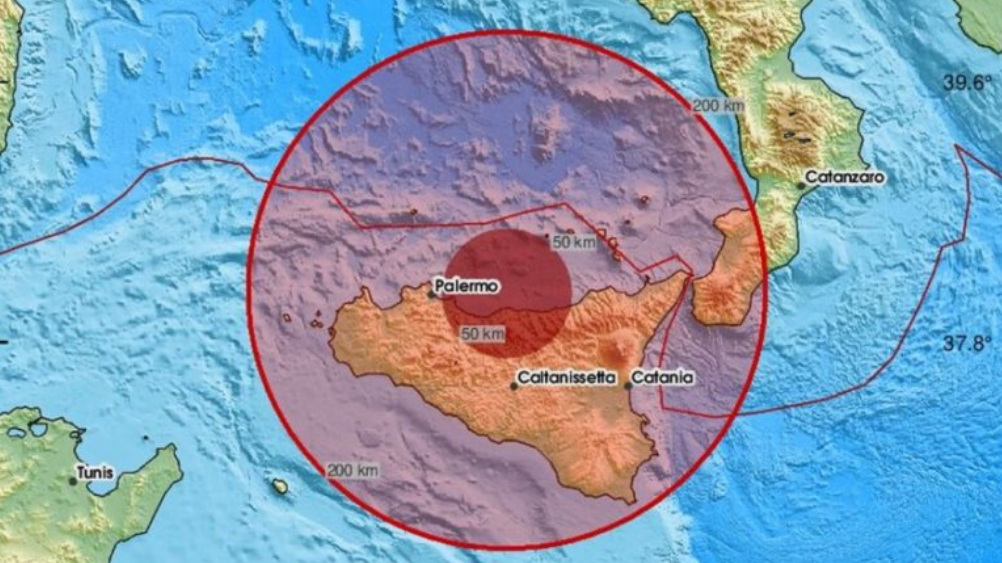
The seismic activity occurred around midday on Friday, when 12 earthquakes were recorded in the area, with reported magnitudes reaching 5.0 in a series of tremors.
As a precaution, schools in Palermo and Messina suspended classes and evacuated students from their buildings. Some public offices were also cleared while local authorities assessed the situation and communicated safety instructions to residents.
Although the alert raised concerns about the possibility of dangerous sea conditions, officials urged the public to follow instructions from emergency services and avoid approaching the coastline until it was considered safe to do so.
Earthquakes Near Sicily Trigger Emergency Measures
In Palermo, Sicily’s regional capital, students left their classrooms as a precaution. Similar measures were reported in Messina, while authorities in other parts of the island also responded to the warnings.
The evacuations were not limited to major urban centres. In Trapani, located along Sicily’s western coastline, precautionary measures were also implemented. On Lipari, students and municipal employees reportedly left buildings as the response to the earthquake sequence continued.
The tsunami alert added another concern because underwater earthquakes can sometimes displace large volumes of water and generate waves that threaten coastal communities.
However, not every earthquake beneath the sea produces a tsunami. The level of danger depends on several factors, including the earthquake’s magnitude, depth, location and the extent to which the seabed moves vertically.
Where Were the Tremors Felt?
Reports indicated that the shaking was felt across several communities in Sicily, including Palermo, Patti, Licata, Capo d’Orlando and Campofelice di Roccella.
Palermo, which has a population of approximately 648,000 people according to the figures cited in the initial reports, was among the main urban centres affected by the precautionary response.
The reported epicentre was less than 60 miles from Palermo, placing the earthquake activity within a relatively short distance of the Sicilian capital.
According to the reported figures, 11 additional earthquakes in the sequence registered magnitudes above 3.0. Although earthquakes of this size can be felt by people near their epicentres, the effects vary depending on depth, distance and local ground conditions.
USGS Records a Magnitude 5.7 Earthquake
The United States Geological Survey (USGS) separately reported an earthquake measuring magnitude 5.7 north of Sicily. The event was recorded at 10:19 a.m. local time, at a depth of approximately 10 kilometres.
The reported magnitude differs from the maximum of 5.0 cited in the account of the 12 tremors. These figures may refer to different measurements, events or reporting updates, so they should not automatically be treated as descriptions of the same earthquake.
The reported depth is also relevant when assessing the potential effects of an earthquake. A relatively shallow earthquake may produce stronger shaking near its epicentre than a deeper event of comparable magnitude, although the actual impact depends on several other factors.
The reported seismic activity near Sicily therefore required continued monitoring, particularly because of the proximity of populated areas and the precautionary tsunami warning.
Palermo Mayor Urges Residents to Stay Away From the Coast
Palermo Mayor Roberto Lagalla said local authorities were closely monitoring the situation and urged residents, particularly those near the coastline, to remain cautious and follow official safety instructions.
Residents were advised to keep their distance from the sea while the tsunami alert remained a concern. During a potential tsunami threat, dangerous changes in sea level or currents may occur before the full extent of the danger becomes apparent.
Authorities rely on seismic monitoring and official warning systems to assess potential risks and determine what precautions are necessary. Residents were therefore urged to take the warnings seriously and avoid returning to coastal areas until authorities confirmed it was safe.
Why Tsunami Alerts Require Immediate Attention
Tsunamis are different from ordinary ocean waves. They can be generated when an underwater earthquake displaces the seabed, pushing a large volume of water and sending waves across the sea.
Depending on the earthquake and the surrounding geography, the resulting waves can reach coastlines with little visible warning. Their effects may be particularly dangerous in bays, harbours and low-lying coastal areas.
A tsunami alert does not necessarily mean that destructive waves will reach land. Instead, it signals a potential threat that requires attention and that people should follow instructions issued by emergency authorities.
Residents in affected areas should move away from the shoreline when instructed, avoid beaches and harbours, and seek higher ground if an evacuation order is issued. They should also remain away from coastal areas until authorities confirm that the danger has passed, as multiple waves can occur and the first wave is not always the largest.