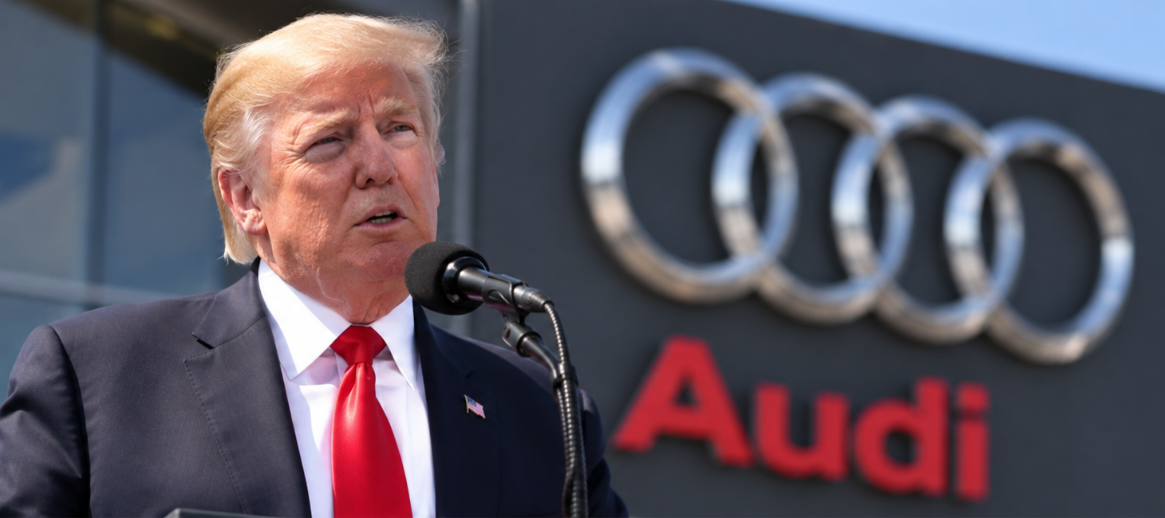
U.S. President Donald Trump has announced plans for German luxury automaker Audi to invest $4.2 billion in Georgia, presenting the proposed project as evidence that his trade policies are encouraging international companies to expand manufacturing operations in the United States.
Speaking at an election rally in Perry, Georgia, Trump said Audi, which is owned by the Volkswagen Group, intends to build a new manufacturing facility in the Macon area. According to his announcement, the proposed plant could eventually produce as many as 200,000 vehicles annually, potentially making it a significant addition to the state’s automotive industry.
The announcement comes as the Trump administration continues to emphasize domestic manufacturing, using tariffs and other trade measures to encourage companies to invest in American production rather than rely on facilities overseas.
The proposed $4.2 billion investment would represent a substantial commitment to automotive manufacturing in Georgia, a state that has attracted growing attention from companies operating in the automotive and advanced manufacturing sectors.
Such a production target would require a considerable manufacturing operation, including assembly facilities, logistics infrastructure, equipment and access to a reliable network of suppliers. Automotive factories also depend on transportation links and a skilled workforce capable of supporting complex production processes.
What the Proposed Factory Could Mean for Georgia
A major automotive investment can create economic opportunities that extend well beyond the factory itself. Vehicle manufacturers typically depend on networks of parts suppliers, transportation companies, maintenance contractors and other businesses that support production.
If Audi moves forward with the project, local companies could potentially benefit from new contracts and increased demand for industrial services. The development could also create employment opportunities in manufacturing, engineering, logistics and administrative operations.
The broader economic impact, however, would depend on the project’s final size, the number of jobs created and the extent to which Audi sources components and services from businesses in the United States.
No specific employment figures or detailed construction timetable were provided in the announcement described above, leaving the project’s potential local impact uncertain.
Audi CEO Gernot Döllner credits President Trump for the company’s new auto investments in Georgia: "I would like to thank Mr. President for your support and the great opportunity." "We are planning to bring our biggest and most premium SUVs and produce them here in Macon!" https://t.co/uaiR7yfu9w
— Republicans (@Republicans) October 25, 2026
Trump Credits His Tariff Policies for the Investment
Trump presented the proposed Audi investment as an example of how his tariff policies could influence the decisions of international manufacturers.
Tariffs are taxes imposed on imported goods. Depending on their structure and the products affected, they can increase the cost of bringing vehicles or components into a country from overseas markets.
The Trump administration has argued that tariffs can encourage companies to establish or expand domestic production. Under this approach, manufacturers may have an incentive to move some operations closer to the customers they serve or to reduce their exposure to import duties.
Why Automakers Consider Manufacturing in the United States
The United States is one of the world’s largest automotive markets, making domestic production strategically important for manufacturers seeking to serve American customers.
However, establishing a new automotive plant requires significant upfront spending. Companies must evaluate whether the expected benefits justify the costs of construction, equipment, staffing and long-term operations.
Tariffs can influence these calculations, but they are not the only factor behind investment decisions. Market demand, production efficiency, incentives and the availability of skilled workers can also shape where manufacturers choose to build facilities.
Although Trump attributed Audi’s proposed investment to his trade policies, further information would be needed to establish how much the tariffs influenced the company’s decision.
Audi is a German luxury car brand owned by the Volkswagen Group, one of the world’s largest automotive manufacturers. If confirmed and completed, the proposed Georgia facility could expand Audi’s manufacturing operations in the United States. However, details about the models to be produced and the plant’s role in the company’s existing production network have not yet been established.
Important Questions Remain About the Project
An independently confirmed announcement from Audi or its parent company would help establish the project’s scope and status. Further information would also be needed to determine when construction might begin, when production could start and whether the stated annual capacity represents an initial target or a longer-term goal.
The employment impact is another important consideration. A factory capable of producing 200,000 vehicles annually could require a substantial workforce, but production capacity alone does not reveal how many people would be employed directly or indirectly.
Until more details become available, the proposed $4.2 billion investment should be understood as a project announced by Trump rather than a fully verified manufacturing development with a confirmed construction schedule.