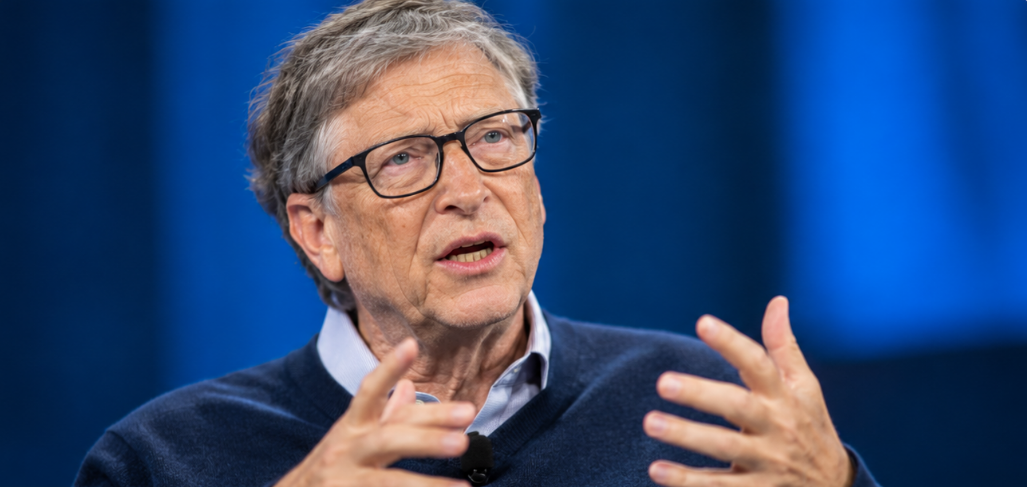
Microsoft co-founder Bill Gates has warned that artificial intelligence could bring two decades of economic and social disruption, fundamentally changing the job market, reshaping industries and transforming the way people live and work.
As AI technology advances at an unprecedented pace, Gates believes the transition toward an increasingly automated economy could create significant challenges for workers, businesses and governments. While the technology promises enormous benefits, he cautioned that society may face a prolonged period of uncertainty before those advantages are widely shared.
In a recent interview, the billionaire philanthropist described a future in which artificial intelligence and advanced robotics could perform many tasks currently handled by humans. However, he emphasized that the shift would not necessarily benefit everyone equally, raising concerns about job displacement, economic inequality and society’s ability to adapt.
“My big concern is this 20-year transition period, where there will be winners and losers and a lot of disruption,” Gates said.
Gates believes the widespread adoption of artificial intelligence could eventually lead to a world in which goods and services become easier and less expensive to produce. However, reaching that point may involve significant economic and social challenges.
According to Gates, the transition could extend over approximately 20 years, during which technological advances may create new opportunities while reducing demand for certain types of human labor.
He stressed that the two-decade timeframe is an estimate rather than a definitive prediction. The actual duration of the transition will depend on how quickly AI capabilities improve, how businesses integrate the technology and how governments respond to its broader consequences.
The uncertainty surrounding these developments makes long-term planning particularly difficult. Unlike previous technological revolutions, which often transformed specific industries over several generations, artificial intelligence has the potential to affect numerous professions within a relatively short period.
Why AI Could Create Winners and Losers
One of Gates’ central concerns is that the economic benefits of artificial intelligence may not be distributed evenly.
Companies that successfully adopt AI could increase productivity, reduce operating costs and develop new products or services. Workers with skills that complement emerging technologies may also find new opportunities.
However, employees whose responsibilities can be automated could face growing pressure to retrain, change careers or compete for a smaller number of available positions.
Meanwhile, communities that depend heavily on occupations vulnerable to automation could experience more significant disruptions.
These differences could deepen existing economic inequalities if the gains from technological progress are concentrated among a relatively small number of businesses and individuals.
Artificial Intelligence and Robots Could Transform Everyday Work
Gates also discussed the possibility that advances in AI and humanoid robotics could eventually allow machines to perform a wide range of physical and intellectual tasks.
While much of today’s artificial intelligence is associated with digital activities such as writing, coding, analyzing information and answering questions, robotics could extend those capabilities into the physical world.
As robotic systems become more sophisticated, they may be able to handle tasks that currently require human movement, coordination and decision-making.
Gates pointed to several areas where these developments could have particularly significant consequences, including construction, agriculture and healthcare.
From Building Homes to Performing Surgery
In construction, advanced robots could eventually assist with building homes, transporting materials and completing repetitive or physically demanding tasks.
Agriculture could also undergo major changes as AI-powered equipment becomes increasingly capable of planting crops, monitoring growing conditions and harvesting food.
In healthcare, artificial intelligence could support medical professionals by analyzing diagnostic information, assisting with treatment decisions and improving the precision of certain procedures.
Gates even raised the possibility of machines eventually performing complex tasks such as surgical operations.
However, these scenarios represent potential future capabilities rather than evidence that today’s AI systems can independently and safely replace skilled professionals in such roles.
Even if the technology becomes capable of handling these responsibilities, regulatory approval, public trust and safety requirements will influence how quickly it is adopted.
Will Humans Still Have Jobs in an AI-Driven Future?
Despite the possibility of widespread automation, Gates suggested that human participation could remain important in several areas of everyday life.
Activities involving personal relationships, emotional connections, creativity and cultural traditions may continue to hold special value even if machines become technically capable of performing similar tasks.
Childcare is one example. Although artificial intelligence could assist parents and caregivers with educational activities or routine responsibilities, many families may still prefer direct human involvement in raising children.
Cooking could also remain a meaningful human activity, even in a world where automated systems can prepare meals efficiently.
Similarly, artistic expression and sporting competitions may continue to attract interest because people value the experiences, personalities and achievements of other human beings.
The distinction is not necessarily whether machines can perform a particular task, but whether society wants them to replace human participation entirely.
The Future of Work May Depend on Human Choices
The possibility of extensive automation raises questions that extend beyond technology itself.
If machines eventually perform a substantial share of economically productive work, governments and businesses may need to reconsider how employment, income and economic security are organized.
Possible responses could include expanded retraining programs, changes to education systems, stronger support for displaced workers and policies designed to distribute productivity gains more broadly.
Some economists and technology researchers have also explored ideas such as shorter working weeks and alternative income-support arrangements, although there is no consensus on which approaches would be most effective.
The outcome will depend not only on what artificial intelligence becomes capable of doing, but also on the decisions societies make about how those capabilities should be used.