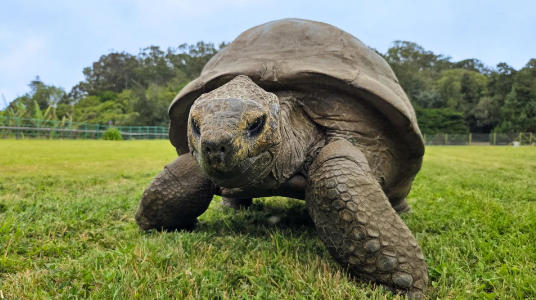
Jonathan the giant tortoise continues to defy the limits of animal longevity. Believed to be the oldest living land animal in the world, the remarkable tortoise has reached the extraordinary age of 194, and scientists may now have uncovered clues explaining how he has survived for nearly two centuries.
The findings come from genetic research involving scientists at the University of Cambridge, who identified 287 distinct genetic variants associated with processes that play an important role in maintaining health and slowing the effects of ageing.
According to the research findings, some of the 287 identified variants are connected to DNA repair, a fundamental process that allows cells to correct damage that occurs throughout an organism’s lifetime.
The genetic variations identified in Jonathan may help strengthen the biological systems responsible for maintaining the integrity of his DNA, potentially allowing his cells to remain functional for much longer.
Another important area highlighted by the findings involves inflammation, insulin regulation and the body’s ability to control the development of cancer.
The genetic variants identified by researchers are linked to mechanisms that help regulate these processes, potentially allowing Jonathan’s body to maintain a healthier balance over time.
Insulin regulation is another biological function of interest.
The researchers also identified variations associated with mechanisms that help suppress the development of cancer.
If Jonathan’s genetic characteristics help his body manage these risks more effectively, they could offer an additional explanation for his extraordinary survival.
Although Jonathan’s genetic profile is particularly unusual, the findings could have implications beyond the study of giant tortoises.
The 287 genetic variants identified in the study could help scientists investigate how DNA repair, inflammation, metabolic regulation and cancer prevention interact to support long-term health.
However, the discovery does not mean that scientists have found a genetic formula capable of extending human life. The biological differences between tortoises and humans are considerable, and the presence of certain genetic variants does not automatically establish that they are responsible for an exceptionally long lifespan.