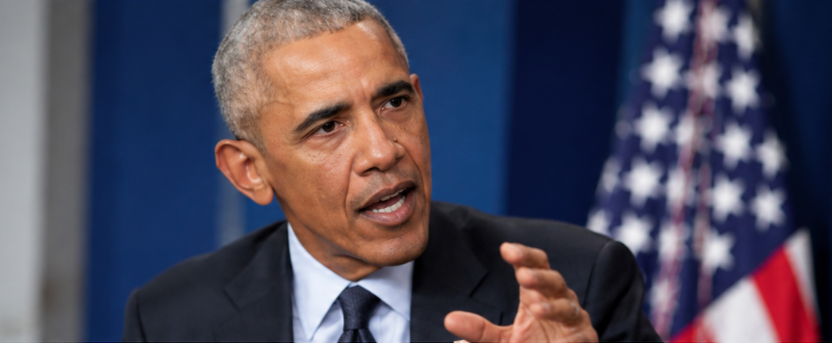
Former U.S. President Barack Obama has launched a sharp attack on President Donald Trump, accusing his administration of corruption, a lack of accountability and mishandling the conflict with Iran, as Democrats intensify their campaigns ahead of the November 3 midterm elections.
Speaking at campaign rallies in Cleveland, Ohio, and Detroit, Michigan, on October 24, Obama urged voters to use the upcoming elections to hold the Republican administration accountable. His remarks focused on Trump’s conduct in office, rising energy costs, the consequences of the Iran conflict and what he described as a failure by Republicans to challenge the president.
Obama’s appearances were part of a broader effort to support Democratic candidates in two closely watched states, where several important races could influence the balance of power in Washington.
One of Obama’s strongest criticisms concerned what he described as Trump’s use of the presidency for personal benefit.
Speaking to supporters in Michigan, where he campaigned for Democratic Senate candidate Abdul El-Sayed, Obama accused the president of benefiting financially from his position while taxpayers bear the costs.
“We’ve never seen a president so intent on selling favors and cashing in on his office,” Obama said.
The former president also directed criticism at Republicans in Congress, arguing that the party had failed to provide meaningful oversight of the administration.
Obama suggested that Republican lawmakers were allowing questionable conduct and ineffective governance to continue rather than fulfilling their responsibilities as elected representatives.
His comments placed government accountability at the center of his appeal to voters, presenting the midterm elections as an opportunity to challenge the administration’s approach without changing who occupies the White House.
The accusations form part of a wider political dispute over Trump’s business interests, government decisions and the relationship between public office and private financial gain. The administration’s critics have raised concerns about potential conflicts of interest, while the broader debate remains a central point of contention between Democrats and Republicans.
Iran Conflict Becomes a Major Point of Contention
Obama also challenged the Trump administration’s claims about its handling of Iran, arguing that the conflict had created serious economic and strategic consequences for the United States.
Rather than strengthening Washington’s position, he argued, the confrontation had given Tehran greater leverage over international energy markets, particularly through its ability to threaten shipping in the Strait of Hormuz.
The narrow waterway between Iran and Oman is one of the world’s most important routes for transporting oil and other energy supplies. Disruptions in the area can affect international shipping, increase uncertainty in energy markets and put upward pressure on fuel prices.
Obama argued that the situation demonstrated the risks of relying on military action without adequately considering its wider consequences.
“Iran now has veto power over the Strait of Hormuz, where oil goes through to get to the world market,” he said during his remarks.
Oil Prices and the Economic Impact on Americans
Energy costs have become an important issue in the run-up to the midterm elections, particularly as households and businesses face pressure from fuel prices and other expenses.
Higher oil prices can affect more than the cost of filling a vehicle. They can also increase transportation expenses, raise the cost of moving goods and contribute to higher prices for products that depend on energy-intensive manufacturing or distribution.
Obama linked these concerns to the administration’s decisions on Iran, arguing that the conflict had added to the financial pressures facing Americans.
The economic argument also carries political significance. Voters frequently assess an administration partly through their everyday experiences with prices, employment and household expenses, making energy costs an important subject during election campaigns.
However, the overall direction of oil prices can be influenced by several factors, including global demand, production levels, geopolitical risks and decisions by major energy-producing countries.
Obama Mocks Trump’s Defense Secretary and White House Renovations
Beyond foreign policy and allegations of corruption, Obama used humor and sarcasm to criticize other aspects of the Trump administration.
He took aim at Defense Secretary Pete Hegseth, arguing that the administration was focusing on issues that were less important than the country’s major economic and security challenges.
He also mocked renovations and decorative changes associated with the White House under Trump, portraying them as unnecessarily extravagant.
Obama compared the lavish aesthetic to the style associated with former Iraqi dictator Saddam Hussein, using the comparison to ridicule what he viewed as an excessive display of wealth and power.
The comments added a personal and theatrical element to the rallies, allowing Obama to combine substantive criticism with humor aimed at energizing Democratic supporters.
Trump’s approach to the White House’s appearance has attracted attention during his presidency, while Democrats have used the subject to question whether the administration is sufficiently focused on issues affecting ordinary Americans.