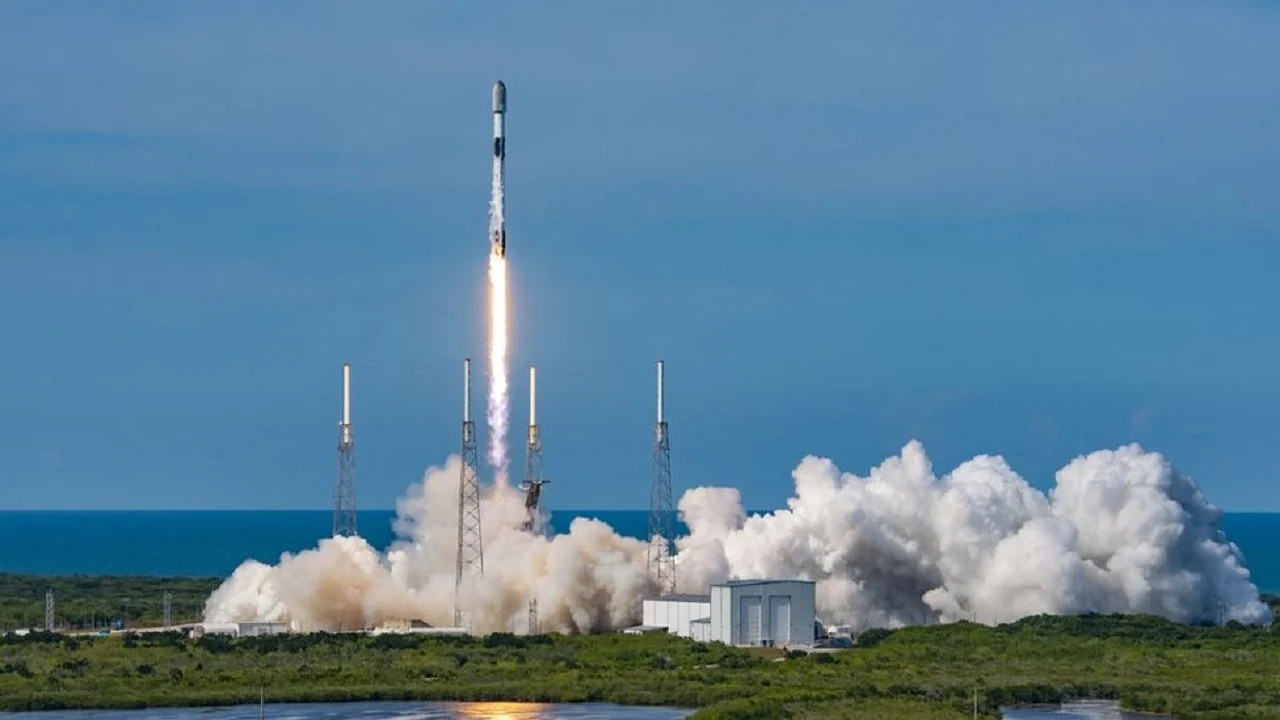
SpaceX has achieved another important milestone in the development of its Starship rocket, successfully sending the spacecraft into Earth’s orbit during its 15th test flight. However, the mission did not go entirely as planned, after a technical problem prevented the company from recovering the rocket’s powerful Super Heavy booster, which plunged into the Gulf of Mexico and erupted in a massive fireball.
The 124-meter-tall rocket, developed by Elon Musk’s SpaceX, lifted off from the company’s Starbase facility in southern Texas. The launch marked another significant step in the company’s efforts to develop a fully reusable transportation system capable of making space travel faster and considerably less expensive.
Despite the dramatic setback involving the booster, the upper portion of the rocket, known as Starship, continued its journey and successfully reached Earth orbit.
During the flight, Starship also deployed 26 satellites belonging to SpaceX’s Starlink network.
Rather than allowing the booster to fall back into the ocean, SpaceX aims to bring it back to the launch site and catch it using two enormous mechanical arms attached to the launch tower. This technique is intended to make it possible to reuse the rocket after landing, avoiding the need to build a new booster for every mission.
The booster failed to return for the planned catch and instead descended into the Gulf of Mexico. Its fall was accompanied by a large burst of flames, creating a dramatic scene as the rocket component came down over the water.
SpaceX confirmed that the precise cause of the recovery failure had not yet been established.
According to the original mission schedule, the spacecraft was expected to complete 14 trips around Earth before making its return on Saturday.
At present, recovering the Super Heavy booster remains one of the company’s most important technical challenges. Catching such a massive structure with mechanical arms requires extremely precise control, as the booster must return to the launch area while traveling at high speeds.
The challenges do not end there. Starship must also withstand the extreme temperatures generated as it re-enters Earth’s atmosphere, making the return journey another demanding stage of the mission.
Beyond its commercial ambitions, the spacecraft has an important role in NASA’s plans for future lunar exploration. Starship has been selected as part of the agency’s Artemis program, which aims to send astronauts back to the Moon.
Musk, meanwhile, has much bigger ambitions for the spacecraft. The billionaire entrepreneur wants Starship to eventually become a vehicle capable of carrying people and cargo to Mars, a destination that remains one of his central long-term goals for SpaceX.
The next major challenge will be demonstrating that the company can safely bring Starship back and catch it at the launch platform, a complex maneuver that could bring SpaceX closer to its vision of making space travel significantly more accessible.