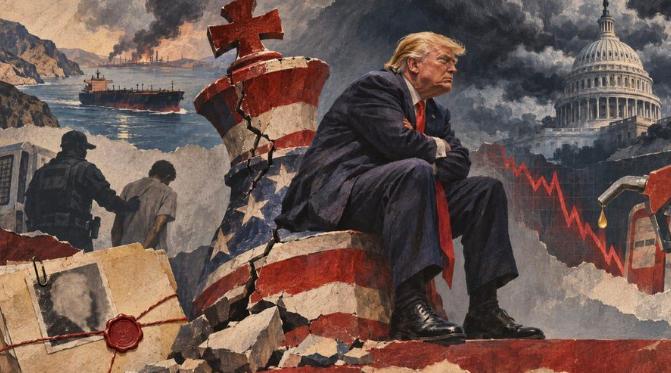
Donald Trump returned to the White House with a strong political mandate and ambitious plans to reshape America. But less than two years into his second presidency, a series of controversial decisions, broken promises and growing public frustration have turned what initially looked like a promising political comeback into a mounting crisis.
From tariffs and rising inflation to the war with Iran, immigration enforcement controversies and questions surrounding his family’s growing wealth, the president has faced a succession of problems that have weakened his standing with voters. Even some of his most loyal supporters have begun questioning his leadership, while Democrats have found new opportunities to challenge his administration.
The chain of events, reconstructed through reporting by The New York Times, The Wall Street Journal, The Washington Post and the Associated Press (AP), reveals how a series of miscalculations helped turn Trump’s second term into a political struggle.
In mid-February 2025, just weeks after returning to the White House, Trump received encouraging news from his economic advisers. Household incomes were rising, retirement accounts were growing and the country’s gross domestic product (GDP) was expanding faster than expected.
Democrats, meanwhile, were struggling to find their footing after their electoral defeat.
“A lot of good things,” Trump reportedly remarked as he considered the opportunities ahead and the possibility of securing a lasting place in American history.
One of the most consequential choices involved Iran. After Israeli Prime Minister Benjamin Netanyahu reportedly persuaded him that eliminating Ayatollah Ali Khamenei could quickly defeat America’s longtime adversary, Trump authorized military action against the country.
He appeared to envision a historic victory that could place him alongside major wartime presidents such as Franklin D. Roosevelt.
Instead, the decision would help set off a chain reaction of economic and political problems, exposing weaknesses in his administration’s judgment and strategy.
Trump’s first major economic gamble came in April 2025, when he made sweeping tariffs a centerpiece of his agenda.
He believed the measures would pressure European countries and other trading partners into making concessions while generating enough government revenue to reduce America’s reliance on the Internal Revenue Service (IRS). At one point, he even entertained the possibility of eliminating the agency altogether.
The tariffs did not produce the expected revenue or trigger the revival of American manufacturing. Instead, they contributed to renewed inflationary pressures and raised concerns about the cost of imported goods.
The Supreme Court would later rule the tariffs unlawful, dealing another blow to a policy Trump had presented as one of the defining achievements of his presidency.
During the 2024 presidential campaign, he repeatedly promised to end Russia’s war against Ukraine within 24 hours of taking office. The pledge appealed to MAGA supporters who wanted the United States to stop committing resources to prolonged overseas conflicts.
But the August 2025 summit with Russian President Vladimir Putin in Alaska did little to bring the war closer to an end.
Trump continued to display a surprisingly friendly attitude toward Putin, while his relationship with Ukrainian President Volodymyr Zelensky remained strained. Their earlier confrontation in the Oval Office had already raised questions about the president’s willingness to stand firmly behind Kyiv.
Still, foreign policy disagreements were not necessarily the biggest threat to his popularity. Many Americans supported his efforts to reduce spending overseas, even if his promised breakthrough in Ukraine never materialized.
His initial strike against Iran’s nuclear program in June was also viewed by some supporters through the same political lens: achieving a significant military objective without becoming involved in another prolonged war.
ICE Shootings Triggered a Backlash Over Trump’s Immigration Policies
Some of the earliest warning signs of a deeper political crisis had emerged on January 7, when immigration enforcement agents shot and killed Renee Good in Minneapolis during federal operations targeting undocumented immigrants.
Good was protesting the enforcement activity and exercising rights protected by the U.S. Constitution.
Around two weeks later, another Minneapolis resident, Alex Pretti, was also killed by federal agents.
The incidents generated intense public anger and raised questions about the conduct of immigration officers and the administration’s aggressive deportation strategy.
Even Melania Trump reportedly expressed concern to her husband, privately warning him that Stephen Miller, the architect of the administration’s mass-deportation policies, was going too far.
Trump eventually moved against some of the officials associated with the controversial operations. Greg Bovino was removed from his position, while Homeland Security Secretary Kristi Noem also faced consequences.
Americans increasingly questioned whether an administration built around the promise of “America First” was actually acting in the country’s interests.
The controversy also created problems among Hispanic voters, some of whom had supported Trump in the previous election but were now reconsidering that decision.
The Epstein Controversy Divided Trump’s MAGA Supporters
Another political problem emerged from the administration’s handling of the Jeffrey Epstein files.
The controversy was particularly damaging because it created divisions within Trump’s own political movement. Some of the most outspoken MAGA supporters began expressing frustration with the president, accusing his administration of failing to deliver the transparency they had demanded.
Among those distancing themselves from Trump was Republican Representative Marjorie Taylor Greene, who had previously been one of his most devoted allies.
The timing of Trump’s decision to launch military action against Iran also attracted suspicion. Critics questioned whether the president had considered the political benefits of shifting media attention away from Epstein while weighing the consequences of a new conflict.
Those suspicions were fueled by the president’s past association with the disgraced financier. The source material also refers to an alleged sexually explicit birthday message Trump sent Epstein.
There is no established evidence that the Iran operation was launched to distract from the scandal, but the controversy added another layer of distrust among voters.
The Iran War Became One of Trump’s Most Costly Decisions
Trump’s decision to attack Iran was initially presented as a military operation that could be completed within six weeks.
The war created tensions with American allies and brought Trump increasingly close to Netanyahu, a relationship that later drew criticism even from Vice President JD Vance.
It also deepened divisions among conservatives. Commentator Tucker Carlson, once an influential Trump supporter, became increasingly critical of the administration’s approach to the conflict.
Military officials and strategists had reportedly warned Trump about the possibility that Iran could close the Strait of Hormuz, a critical international shipping route through which a substantial share of the world’s oil supply passes,but their warnings went unheeded.
The consequences were felt far beyond the battlefield. Disruptions to energy supplies sent gasoline prices higher, while the broader cost of living became another source of frustration for American households.
Trump’s Growing Family Wealth Raised Questions About Corruption
As ordinary Americans struggled with higher living costs, questions about the financial interests of Trump and his family became increasingly prominent.
One particularly controversial proposal involved selling advance access to the president’s social media messages. Because Trump’s public statements could influence financial markets, critics raised concerns about the possibility of people paying for information that could give them an advantage in trading.
Public opinion surveys increasingly showed that corruption was becoming an important issue for voters, creating another problem for a president who had promised to clean up Washington.
At the same time, Trump continued making ambitious financial promises to the public. During the Dallas convention, he reportedly pledged $5,000 for every American in an effort to encourage support for his preferred candidates.
As his approval ratings weakened, some of Trump’s advisers reportedly encouraged him to reduce his public appearances and avoid drawing unnecessary attention to the administration’s problems. Rather than stepping back, he continued placing himself at the center of the political debate, effectively turning the midterm elections into a referendum on his own leadership.
His repeated promotion of the extravagant ballroom project under construction at the White House further reinforced the impression that he was more interested in personal grandeur than the everyday concerns of Americans.
The Midterm Election Backlash Marks a Major Setback for Trump
By the time voters went to the polls, the problems had accumulated across nearly every major area of Trump’s presidency.
Economic dissatisfaction, controversial immigration operations, the Epstein controversy, divisions within MAGA and the consequences of the Iran war had combined to weaken the political coalition that had helped return him to power.
Trump had entered his second term with considerable public support and an opportunity to consolidate his influence over American politics.
Instead, his decisions increasingly turned former allies into critics and gave his opponents a powerful argument against his leadership.
Unlike the French Revolution, the upheaval was not violent. It unfolded through ballots rather than barricades.
But the political symbolism was unmistakable: Trump had helped turn the midterm elections into a judgment on his presidency, and voters delivered their verdict.