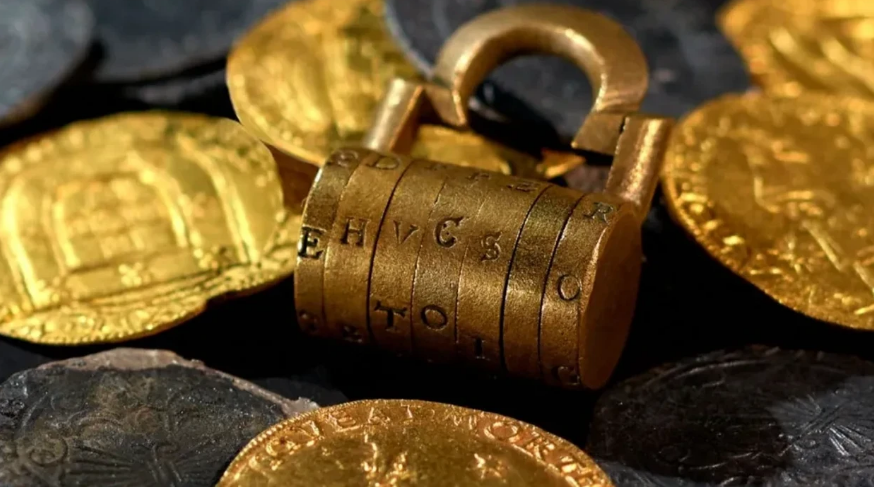
A centuries-old mystery has finally been solved after researchers uncovered the four-letter combination needed to open an ancient brass lock recovered from a shipwreck off the coast of Wales.
The unusual artefact, believed to be around 400 years old, had puzzled experts and its discoverer for decades. Despite numerous attempts to work out its combination, the lock remained closed until specialists used modern scanning technology to examine its internal mechanism and reveal the hidden code.
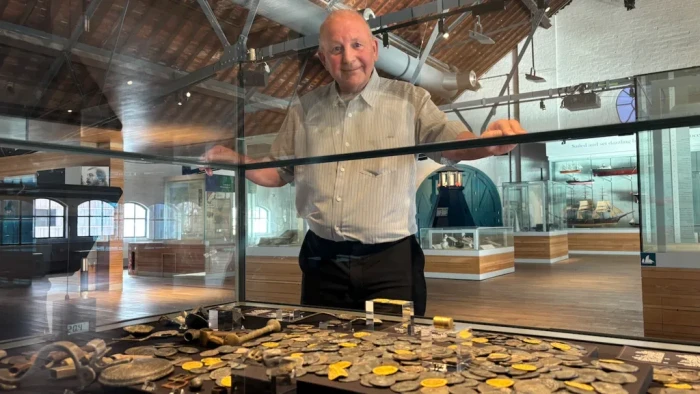
The lock was discovered in 1999 by metal detector enthusiast Peter Hughes on the beach near Margam, in Port Talbot, Wales. It was among hundreds of historical objects recovered from the area, many of which are believed to have belonged to a Spanish-bound trading vessel called the Ann Francis.
The ship was caught in a violent storm on December 28, 1583, while returning from Spain. Its valuable cargo was lost beneath the sand, where it remained hidden for centuries.
Hughes, who lives in Maesteg, had been exploring Morfa Beach with his metal detector when he came across a coin. What initially appeared to be a routine discovery eventually led him to uncover hundreds of objects connected to the historic shipwreck.
“It was a complete accident on a day off. I was walking along the beach with my metal detector when I found a coin. That was the beginning of a journey that lasted 21 years,” the 69-year-old recalled.
Among the recovered items were Spanish silver coins, two coin scales and the small brass combination lock.
Although experts have not established exactly what the lock was used for, its location among valuable objects has led to several possibilities.
It may have secured a small chest containing the silver coins or protected a box holding other valuable possessions. Documents, textiles and personal belongings are also among the possible contents, although none of these materials have survived in the archaeological collection.
According to senior curator Siân Iles, the lock’s relatively small dimensions suggest that it was probably designed to secure a compact container rather than a large chest.
“I tried to open it for about 20 years. I kept moving the rings and searching for the right combination, but without success. With the help of modern technology, we managed to solve what could truly be described as a Da Vinci-style code,” he said.
“For me, it was like opening the Ark of the Covenant. I am absolutely delighted and genuinely excited,” Hughes added.
Modern Scanning Technology Cracks the Ancient Code
The breakthrough became possible after researchers turned to micro-computed tomography, commonly known as micro-CT scanning.
Rather than attempting to force the lock open or dismantle its historical components, researchers could use the scans to investigate the internal arrangement of its mechanism.
Dr David Williams, a research associate at Cardiff University’s School of Engineering, initially had doubts about whether the equipment would be suitable for solving such an unusual problem.
“It is a challenge because the equipment we have was not specifically designed for this purpose,” he explained.
However, the research team decided to experiment with different scanning approaches.
The first scan produced an unexpected result: researchers were able to identify the letters on the lock’s internal mechanism. A second attempt was unsuccessful, but the team did not abandon the investigation.
For the third scan, Williams and his colleagues adjusted their approach and eventually managed to obtain the information needed to identify the correct combination.
“We carried out the first scan to see whether we could identify anything, and we were surprised when we managed to see the letters. The second scan failed completely, but for the third attempt, we tried a different approach and succeeded in uncovering the code. I was amazed that we managed to do it,” he said.
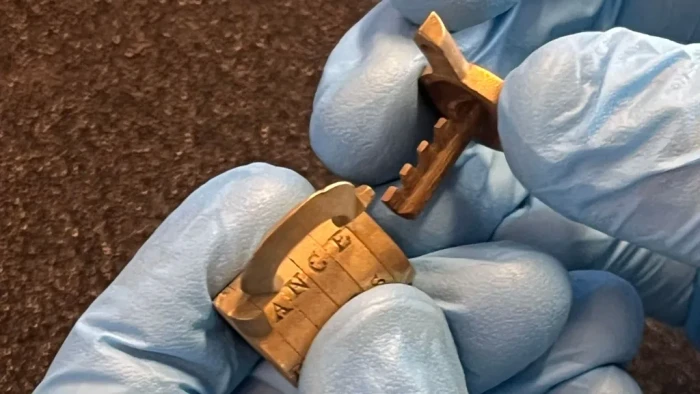
The researchers eventually identified the four-letter combination as ANCE.
The discovery demonstrated how modern imaging technology can help archaeologists and museum specialists investigate historical objects without physically damaging them.
In this case, a technique originally associated with medical imaging helped solve a puzzle that had resisted traditional examination for years.
Why Finding the Correct Combination Was So Difficult
According to senior curator Alastair Willis, identifying the code was particularly challenging because of the way the lock had been constructed.
The mechanism featured four separate rotating rings, each containing six letters.
This created a total of 1,296 possible combinations, meaning that simply trying different arrangements would have been a time-consuming process.
Even more confusingly, the lock featured additional letters positioned around its outer edges. These characters did not move with the combination rings and were not part of the actual code.
“To make things even more complicated, there were additional letters around the edges of the lock that did not move and had nothing to do with the combination. They appear to have been included to confuse potential thieves,” Willis said.
The four rotating rings had to be aligned precisely with the locking mechanism at the top of the device. Without the correct arrangement, the lock could not be released.
Another remarkable aspect of the discovery is the condition of the brass lock.
Senior curator Siân Iles said the artefact had survived in unusually good condition compared with many other historical locks.
“This is a wonderful example of a lock that still works in exactly the way it would have hundreds of years ago,” she said.
The fact that it was recovered close to the remains of the Ann Francis, alongside other objects from the same collection, has also helped experts establish its historical context.
After years of searching and collecting, Hughes eventually handed over his collection of artefacts to Amgueddfa Cymru in 2017.
The brass lock became one of the central objects in the collection, which was put on display at Swansea Waterfront Museum in July 2026.
Although researchers have now revealed the lock’s secret combination, its original purpose and the identity of the person who used it remain unknown.
“It is a small object, so it was probably used to secure a chest or a small box. We do not know what was inside, and that is part of the story. There are things we may never discover, but this lock was important to the person who knew the combination,” she explained.