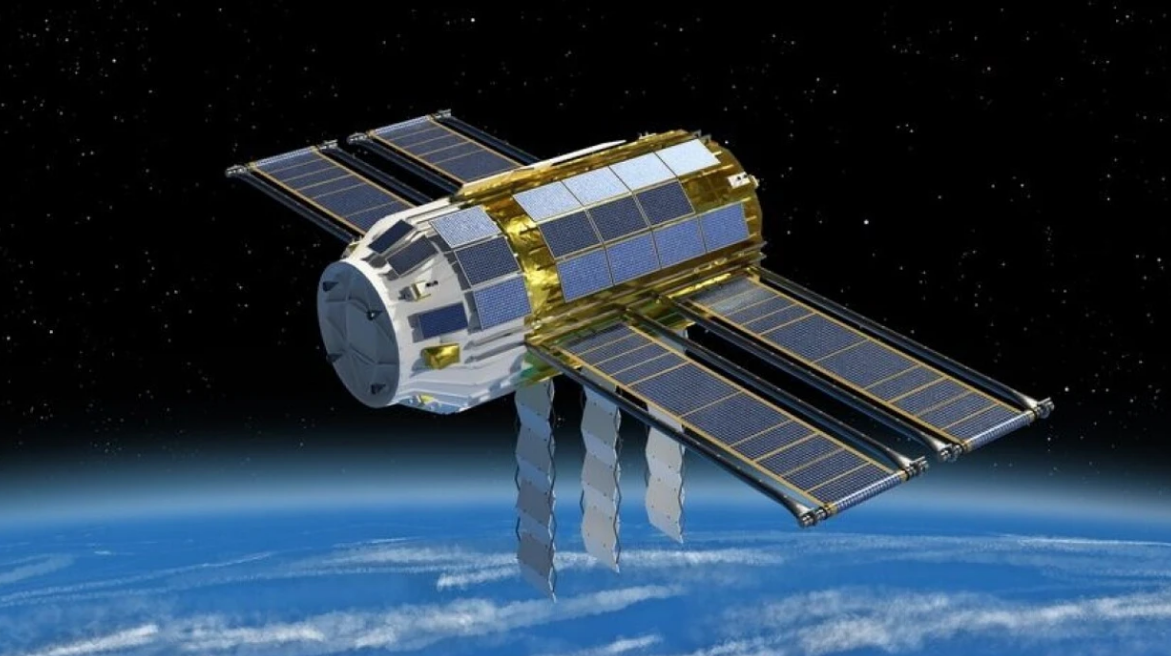
Google has reached an important milestone in its effort to bring artificial intelligence computing beyond Earth. The company’s experimental satellite, developed as part of its Project Suncatcher initiative, has successfully activated its onboard processors and established communication with ground stations, marking an early step toward the possibility of operating data centers in orbit.
The experimental spacecraft was launched earlier this month aboard a SpaceX Falcon 9 rocket. Unlike conventional satellites designed primarily for communication, navigation, or observation, Google’s project explores whether powerful computing systems can operate directly in space and handle demanding artificial intelligence workloads.
The satellite is equipped with four Tensor Processing Units (TPUs), specialized processors developed by Google to accelerate AI operations. Their performance in orbit will help the company determine whether the technology can withstand the challenging conditions of space while maintaining reliable computing capabilities.
During one of the initial tests, engineers asked the Gemma 4 AI model installed aboard the satellite to write a short poem about space. The experiment provided an early demonstration that the onboard computing hardware could process an AI request and generate a response that could be communicated back to Earth.
A ‘hello world’ milestone for Project Suncatcher 🚀 After launching our prototype satellite a few weeks ago, we’ve now successfully sent a command up to orbit, booted up the TPU, ran the prompt, and received our first complete response back on earth – a haiku! https://t.co/kOFmETUskm
— Sundar Pichai (@sundarpichai) October 30, 2026
Project Suncatcher is Google’s experimental initiative to investigate the possibility of building networks of satellites that function as data centers in space.
The idea is to move some of the computing infrastructure needed for artificial intelligence away from traditional facilities on Earth. Instead of relying entirely on buildings filled with servers, cooling systems, and extensive electrical infrastructure, future AI computing systems could potentially operate aboard specialized spacecraft.
The concept is particularly interesting because artificial intelligence requires enormous computing resources. Training advanced models and responding to millions of user requests can involve substantial amounts of electricity, powerful processors, and sophisticated cooling infrastructure.
As demand for AI services continues to increase, technology companies are searching for alternative ways to expand their computing capacity. Google’s orbital approach is one experimental possibility being explored.
Four Tensor Processors Will Be Tested in Extreme Conditions
Google has equipped the spacecraft with four Tensor Processing Units, commonly known as TPUs. These processors are specifically designed to accelerate machine learning and artificial intelligence calculations.
However, operating this technology in space introduces challenges that do not exist in conventional data centers.
Temperature Changes and Radiation Pose Major Challenges
Electronic components in orbit must operate in an environment exposed to extreme temperature variations and radiation.
On Earth, data centers use carefully controlled environments to protect sensitive hardware. Cooling systems, ventilation, and other infrastructure help maintain stable operating conditions and prevent processors from overheating.
A satellite cannot rely on the same arrangements. Its electronics must function within the limitations of a spacecraft, where temperature management and protection against radiation are essential engineering considerations.
Radiation is another significant concern. High-energy particles in space can interfere with electronic components, potentially causing temporary errors or permanent damage. This makes long-term reliability a major question for any company hoping to operate sophisticated computing equipment in orbit.
Google has confirmed that the experimental satellite is operating normally. The next phase of testing will focus on determining how well its processors withstand these environmental conditions.
The results will help engineers understand whether specialized AI hardware can maintain consistent performance over extended periods in space.
Why Google Wants to Build Data Centers in Space
The motivation behind Project Suncatcher goes beyond simply demonstrating that an AI model can write a poem while orbiting Earth. Google is investigating whether space could eventually provide an alternative environment for large-scale computing infrastructure.
One potential advantage is access to solar energy. Satellites operating in suitable low Earth orbits could receive sunlight for extended periods, potentially generating substantial amounts of electricity through solar panels.
Google has suggested that space-based solar power could offer significant advantages over conventional solar installations on the ground. Its research explores the possibility that future satellite networks could use this energy to support increasingly demanding AI operations.
Moving some computing operations into orbit could eventually reduce certain limitations associated with terrestrial facilities. However, this does not mean that space-based data centers would automatically be cheaper or easier to operate.
Launching heavy computing equipment into orbit remains expensive, while maintaining and replacing hardware in space presents additional technical difficulties.
Satellites Could Eventually Work Together
Another important part of Google’s vision involves connecting multiple satellites into a coordinated computing network.
Rather than having each spacecraft operate independently, future satellites could communicate with one another through optical laser links. These connections would allow information to move between spacecraft at high speeds, potentially enabling them to distribute computing tasks across an orbital network.
This approach could make it possible to handle larger AI workloads than a single satellite could manage on its own.
However, establishing reliable connections between moving spacecraft requires extremely precise positioning and communication technology. Satellites must maintain their relative positions while traveling at high speeds around Earth.
Google is exploring ways to overcome these challenges as part of its longer-term research program.
Google Plans Another Major Test in 2027
The successful first AI response is an encouraging result, but Google still has several important stages to complete before its vision becomes practical.
The next phase will focus on testing the processors under real orbital conditions, particularly their ability to withstand radiation and extreme temperature changes while performing computing tasks.
If the results are promising, Google plans to move toward its next major milestone in 2027: launching two interconnected satellites.
These spacecraft are expected to feature greater power-generation capabilities and optical laser communication technology. The experiment will allow engineers to investigate whether separate satellites can exchange information and work together as part of a distributed computing system.
The findings could help Google determine what kind of hardware, energy systems, and communication infrastructure would be required to expand the project.
When Could Space-Based AI Data Centers Become Economically Viable?
Google is not presenting Project Suncatcher as a technology that will immediately replace traditional data centers. The initiative remains an early-stage research project, and several engineering challenges must be resolved before orbital computing could become commercially practical.
Google hopes to make the technology economically viable during the 2030s.
Reaching that goal will depend on several factors, including the cost of launching equipment, the lifespan of onboard processors, the availability of solar energy, and the ability to maintain reliable communication between satellites.
Cooling will also remain a particularly important challenge. Unlike facilities on Earth, where air-based cooling systems can be used, satellites must transfer excess heat through specialized equipment such as heat pipes and radiators.
These obstacles mean that significant technological improvements and further testing will be necessary before large orbital computing networks become a realistic option.