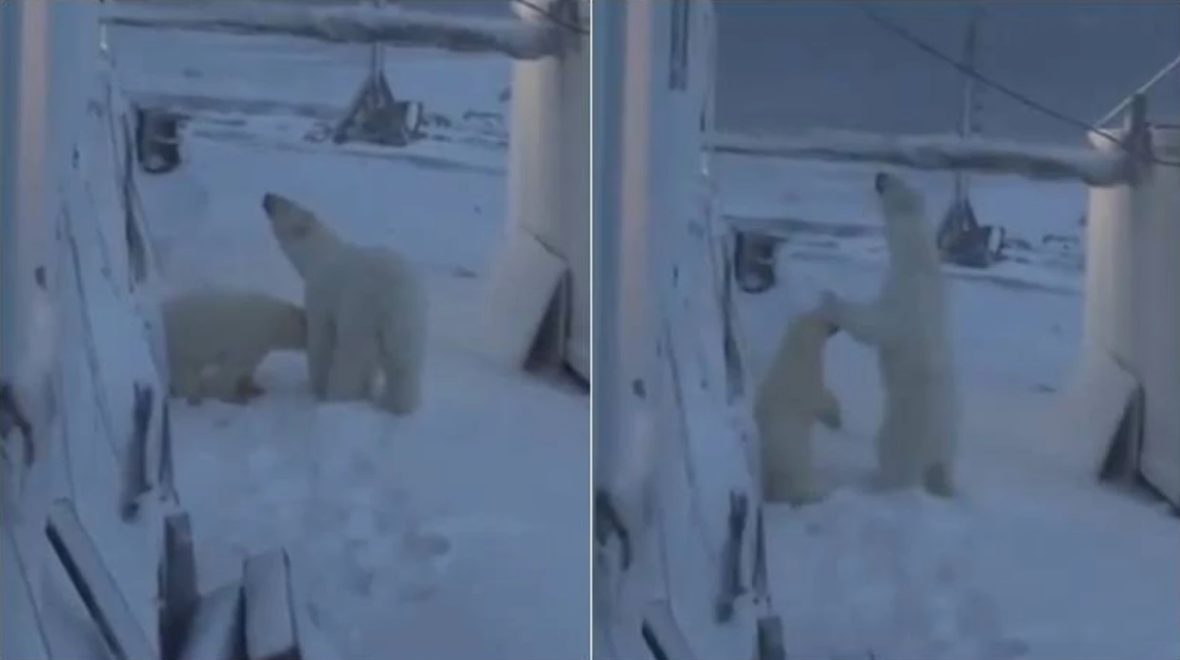
A group of polar bears has attracted attention online after approaching a remote weather station in northern Russia and seemingly attempting to get inside the building. The unusual encounter was captured on video at Cape Chelyuskin, one of the northernmost points of mainland Eurasia, where researchers carry out meteorological observations in the harsh Arctic environment.
The footage shows several polar bears gathering around the hydrometeorological station, moving close to the building and appearing particularly interested in what was inside. At certain moments, the animals seem determined to find a way into the structure, creating an unusual scene for the researchers who work in this isolated part of the world.
Polar bears pay a visit to researchers and try to break into a weather station At Cape Chelyuskin, the bears approached the hydrometeorological station building and, judging by the footage, were very eager to get inside. However, the bears never actually came face-to-face with the station staff.
— NEXTA (@nexta_tv) October 26, 2026
Although polar bears are commonly associated with the vast Arctic wilderness, encounters near research facilities and other human structures are not entirely unusual in regions where the animals naturally roam.
The incident took place at Cape Chelyuskin, located on the Taymyr Peninsula in northern Siberia. The area is known for its extreme weather conditions, long winters and remote geographical position, making it a challenging location for scientific research.
The hydrometeorological station serves as an important observation point for researchers monitoring weather conditions in the Arctic. Scientists working in such facilities collect information about temperatures, atmospheric conditions, wind patterns and other environmental changes that help improve understanding of the region.
Their behavior quickly caught the attention of viewers, as the footage captured a rare and somewhat amusing example of wildlife coming unusually close to a human research facility.
Despite the bears’ apparent interest in entering the building, they did not come face-to-face with the station’s personnel.
Researchers Work in One of the Arctic’s Most Isolated Regions
The region’s geographical position makes it valuable for monitoring changes in the Arctic atmosphere and weather systems. Information collected at stations like this can contribute to broader meteorological research, including the study of temperature fluctuations and changing climate conditions.
Working in such an environment also means that researchers must be prepared for encounters with wildlife.
Polar bears are among the most recognizable animals in the Arctic, but they are also powerful predators. Their natural habitat includes sea ice, coastal areas and surrounding tundra, where they search for food and travel across large distances.
When research stations are located within or near their natural range, encounters between the animals and people can occasionally happen.
For personnel working in these locations, maintaining secure buildings and following wildlife safety procedures is an important part of everyday life.
Why Polar Bears Sometimes Approach Human Buildings
Polar bears are naturally curious animals, and their powerful sense of smell plays a major role in how they explore their surroundings.
They can detect potential food sources over considerable distances, making unfamiliar structures, vehicles and other human-made objects interesting targets for investigation.
Food odors, waste and other scents can sometimes attract bears toward places occupied by people. Once nearby, they may investigate doors, windows and other parts of a building.
Nevertheless, such encounters should never be treated as harmless entertainment. Polar bears are extremely strong animals, and even seemingly playful or curious behavior can create dangerous situations for anyone nearby.
For people living or working in Arctic communities, keeping food securely stored, managing waste properly and maintaining appropriate protective measures can help reduce the risk of unwanted encounters.
Polar Bears Face a Changing Arctic Environment
Beyond the unusual footage, the encounter also brings attention to the environment in which polar bears live.
Polar bears depend heavily on sea ice, which provides an important platform for hunting seals, their primary food source. They use the ice to travel, find prey and move between different areas of their Arctic habitat.
As Arctic temperatures rise, sea ice has been declining in many regions, changing the conditions in which these animals survive.
When access to sea ice becomes more difficult, polar bears may spend more time on land, where they sometimes encounter human settlements, research stations and other infrastructure.
These interactions can increase the potential for conflict between wildlife and people, particularly in remote northern communities.
Scientists continue to monitor polar bear populations and their habitats to better understand how environmental changes are affecting their behavior and long-term survival.
Viral Video Captures an Unusual Arctic Encounter
The footage from Cape Chelyuskin was shared by the social media account NEXTA on October 26, 2026, and quickly attracted attention online.
The encounter offers a glimpse into the challenges of working in the Arctic, where researchers must carry out their duties while sharing the surrounding environment with some of the world’s largest land predators.
Although the bears never came into direct contact with the station’s staff, their unexpected visit provided a memorable moment that quickly spread across social media.
For those watching from a distance, the scene may look amusing. For the people working inside the station, however, having a group of curious polar bears outside the building is a reminder that life in the Arctic can be unpredictable.