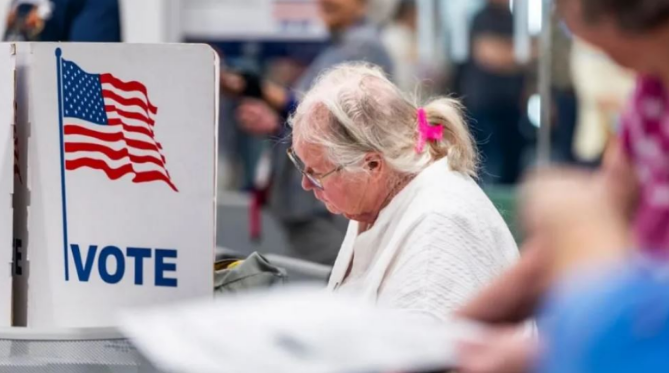
More than 43 million Americans have already cast their ballots ahead of the upcoming U.S. midterm elections, signaling strong voter participation just days before Election Day. With control of Congress at stake, early voting figures are drawing attention to several closely watched states, particularly Texas, where turnout has surged beyond levels recorded during the previous midterm elections in 2022.
The elections, scheduled for November 3, will determine which political party controls Congress for the next two years. The outcome could have significant consequences for President Donald Trump’s administration, as Republicans and Democrats compete for influence in both the House of Representatives and the Senate.
According to data compiled by the University of Florida’s Election Lab, between four and five million Americans have been casting early ballots each day. The pace is considerably higher than what has been recorded during many previous election cycles, highlighting the importance voters are placing on this year’s congressional contests.
Among the states attracting the most attention is Texas, where early voting numbers have already surpassed those recorded during the 2022 midterm elections.
According to Mike McDonald, a professor who oversees the University of Florida Election Lab’s early voting database, approximately 5.8 million ballots have been cast in Texas so far. That represents roughly 1.75 million more votes than the state recorded during the comparable period of the 2022 election cycle.
Although Texas has traditionally been a Republican stronghold in statewide elections, changing voting patterns and growing political competition have made turnout figures particularly important for both parties. The state’s large population and its influence in national politics mean that even relatively small shifts in participation could attract considerable attention.
The Senate race in Texas is especially significant because the result could help determine the balance of power in the upper chamber of Congress. Both parties are closely monitoring voter participation as they look for signs of enthusiasm among their respective supporters.
Hispanic Communities Draw Particular Attention
Another notable development in Texas is the increased participation reported in several communities with large Hispanic populations.
Although the state does not require voters to identify their political affiliation or race when casting ballots, election data indicate stronger early voting activity in certain counties along the U.S.-Mexico border.
In some of these areas, Hispanic residents account for more than 90% of the population, making them important communities to watch as election officials and political analysts examine turnout patterns.
However, higher turnout alone does not necessarily indicate which party is benefiting. Voters from the same demographic group can hold very different political views, and participation figures cannot reveal how individuals have voted.
Democrats Account for a Larger Share of Recorded Early Votes
Preliminary figures also suggest that Democratic voters have accounted for a larger share of early ballots in states that track party registration.
According to data released on Thursday, Democrats represented approximately 44% of recorded early voters, compared with 31.2% for Republicans. Another 24.7% of voters had no declared party affiliation.
Nevertheless, election analysts caution against interpreting the numbers as a prediction of the final results.
The available data cover only around half of the states that record voters’ party affiliations. Furthermore, party registration does not reveal which candidates voters actually supported when submitting their ballots.
A registered Democrat could vote for a Republican candidate, just as a registered Republican could support a Democratic candidate. Independent voters may also play an important role in determining the outcome of competitive races.
Republican Turnout Remains Relatively Stable
While Democratic participation appears higher in the available early voting data, Republican turnout has generally remained close to the levels recorded during the 2022 midterm elections.
In some previous elections, Republicans placed greater emphasis on voting in person on Election Day, while Democrats encouraged supporters to take advantage of early voting and mail-in ballots.
Political strategies have evolved since then, and both parties have increasingly focused on encouraging supporters to vote before the official election date.
The current figures therefore provide only a partial picture of the overall political landscape. Election Day turnout could still change the balance significantly, particularly in states where races are expected to be close.
Black and Hispanic Voter Participation Also Increases
Beyond Texas, early voting data point to increased participation among Hispanic and African American communities in several important states.
North Carolina, Georgia and Florida are among the states where analysts have observed notable activity among these demographic groups.
Georgia, for example, has become one of the country’s most closely watched political battlegrounds. North Carolina and Florida also attract significant attention because of their competitive political environments and large voting populations.
Increased participation among minority communities could influence several congressional races, although the political impact will depend on individual voting preferences, turnout across other demographic groups and the candidates competing in each district.
Early Voting Has Changed the American Election Process
Early voting has expanded considerably over the past several years, particularly following the COVID-19 pandemic. During that period, many states introduced or expanded options that allowed residents to participate without visiting polling stations on the official election date.
The shift became especially visible during the 2020 presidential election, when more than two-thirds of all votes were submitted before Election Day.
More Voters Are Choosing to Cast Ballots in Person
According to Mike McDonald, voters are increasingly showing a preference for casting their ballots in person, even when they choose to vote before Election Day.
This development could reflect changing attitudes toward mail-in voting, although researchers do not yet have enough evidence to identify one definitive explanation.
In-person voting can provide a more direct experience, allowing voters to complete the process at a polling location and receive assistance if necessary.
Still, it would be premature to conclude that concerns about mail voting are the main reason behind the shift. Other factors, including convenience, election administration and changes in voter behavior, could also contribute.
November 3 Election Could Shape the Next Two Years in Washington
Control of Congress will influence the administration’s ability to advance legislation, shape federal spending priorities and pursue its broader political agenda.
For Republicans, maintaining control of Congress would provide President Trump with greater support for his legislative priorities. For Democrats, gaining seats could strengthen their ability to challenge the administration and influence decisions in Washington.
Although more than 43 million Americans have already voted, millions of others are expected to participate on November 3.
The early voting figures suggest considerable interest in the election, but they do not yet reveal which party will ultimately emerge victorious. The final outcome will depend on the votes cast across the country, including those submitted on Election Day.
With control of Congress hanging in the balance, the remaining days of the campaign could prove decisive for both parties.