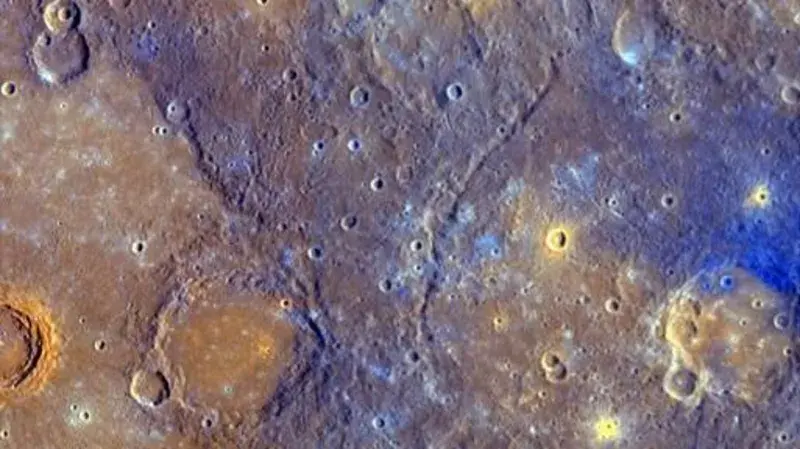
After travelling nearly 10 billion kilometres through space, a spacecraft launched eight years ago is approaching one of the most challenging destinations in the Solar System. The European-Japanese mission BepiColombo is nearing Mercury, where it is expected to enter orbit.
Mercury presents an exceptionally difficult environment for any spacecraft attempting to study it. As the closest planet to the Sun, it experiences some of the most extreme temperature variations in the Solar System. Temperatures on its surface can climb to around 430 degrees Celsius before dropping to approximately minus 180 degrees.
According to the BBC, one of the major questions researchers hope to investigate concerns the presence of ice inside craters on Mercury. Considering how close the planet is to the Sun, the discovery of frozen water in certain locations has long attracted scientific interest.
Researchers are also keen to understand the origin of unusual hollows scattered across Mercury’s surface. These mysterious formations have raised questions about the processes responsible for creating them, and further observations could help scientists establish how they developed.
“I believe Mercury is somewhat of a neglected planet in the inner Solar System, but that’s exactly what makes it so interesting,” said Professor Emma Bunce from the University of Leicester, one of the mission’s lead scientists.
The BepiColombo mission is a joint project between the European Space Agency (ESA) and the Japan Aerospace Exploration Agency (JAXA). The spacecraft was launched in 2018 from French Guiana, beginning a journey that would require an unusually complicated route through the inner Solar System.
The enormous gravitational pull of the Sun presented a significant challenge. As the spacecraft moved closer to the centre of the Solar System, it needed to carefully manage its speed and direction to avoid being pulled into an unsuitable trajectory.
To overcome these difficulties, mission planners designed a series of gravitational assistance manoeuvres. During its journey, BepiColombo completed one flyby of Earth, two encounters with Venus and six flybys of Mercury itself.
The journey was originally expected to take seven years. However, technical problems involving the spacecraft’s propulsion system forced the mission team to revise its schedule, adding another year to the planned journey.
Entering Mercury’s orbit is considered an especially delicate operation because the spacecraft must perform a complicated manoeuvre lasting approximately 37 minutes. During this critical period, Mercury’s gravitational pull must capture the spacecraft and keep it travelling around the planet rather than allowing it to continue into space.
The operation leaves little room for error. If something goes wrong during the manoeuvre, BepiColombo could pass Mercury without successfully entering orbit, putting the mission’s main scientific objectives at risk.
Mercury has received far less attention from space exploration programmes than many other planets. So far, only two spacecraft have visited it, and both belonged to NASA missions.