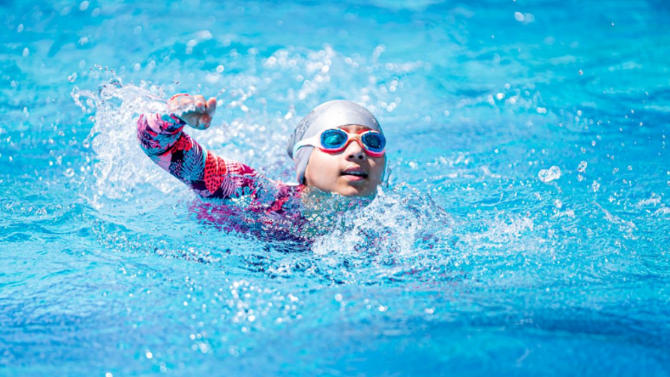
Children who learn to swim at an early age may gain more than the ability to stay safe in the water. According to a four-year study involving thousands of participants, swimming lessons could also give young children an advantage in the classroom, helping them develop stronger reading, mathematics, language and social skills before they even begin school.
The research suggests that children who start swimming before their fifth birthday may be between five and 18 months ahead of their peers in certain developmental abilities. These differences were observed in areas such as reading, mathematics and the ability to understand and follow instructions, regardless of the children’s socioeconomic backgrounds.
The four-year research project included responses from nearly 7,000 participants through surveys, while 177 children underwent individual assessments. Its findings were analyzed by Robyn Jorgensen, professor emerita at the University of Canberra in Australia.
However, Jorgensen emphasized that the results should not be interpreted as evidence that children who swim are naturally more intelligent.
Instead, she believes that the activities involved in swimming lessons help young children develop practical abilities that can later be applied in a classroom environment.
For example, swimming instructors often ask children to repeat movements, count their kicks or follow a sequence of instructions. An apparently simple exercise, such as counting leg movements from one to ten, can introduce basic mathematical concepts, including number recognition and numerical order.
Swimming lessons also require children to listen carefully, remember instructions and coordinate different movements. Over time, these activities can encourage skills that are useful beyond the swimming pool.
Language, Emotions and Social Skills Also Play a Role
The potential advantages are not limited to mathematics and reading. The research also points to connections between early swimming lessons and the development of language, emotional management and social abilities.
During lessons, young children regularly communicate with instructors, respond to questions and learn new words associated with movements and activities. These interactions can create opportunities to strengthen their understanding of language and improve their ability to express themselves.
For a young child, entering a swimming pool, trying unfamiliar movements and gradually becoming comfortable in the water can be a challenging experience. With encouragement and repeated practice, children learn to manage uncertainty, build confidence and become more independent.
Following instructions in a group environment can also help them understand routines, cooperate with others and interact with children of a similar age.
Although the findings highlight several possible developmental benefits, they do not establish that swimming alone is responsible for these differences. Rather, the researchers point to the range of physical, cognitive and social experiences that swimming lessons can provide during early childhood.
The Cost of Swimming Lessons Remains a Major Barrier
Despite the encouraging findings, access to swimming lessons is far from equal. For many families, the cost of regular classes makes it difficult to provide their children with the same opportunities.
In countries such as the United States and China, structured swimming lessons are largely more accessible to households with higher incomes. Similar financial and geographical challenges exist in Australia, Brazil, Singapore and South Africa.
In some rural communities, the problem goes beyond the price of lessons. Families may have to travel hundreds of kilometres to reach the nearest swimming pool, making regular attendance difficult or even impossible.
This creates a troubling contradiction. Children living in lower-income households and remote areas often have fewer opportunities to learn an essential life skill, even though they may face a greater risk of drowning.
Jorgensen believes governments should take a more active role in making swimming lessons accessible to children, particularly those from disadvantaged families.
She has called for subsidized swimming programs and initiatives designed specifically to support households that cannot afford regular instruction.