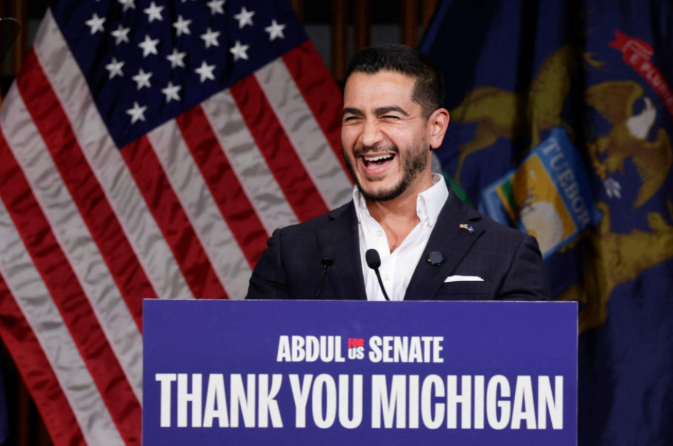
Abdul El-Sayed has achieved a historic political victory in Michigan, defeating Republican Mike Rogers in one of the most closely watched Senate races of the 2026 midterm elections. The progressive Democrat will become the first Muslim ever elected to the U.S. Senate, marking a major milestone in American political history.
His victory comes after a campaign filled with personal attacks, fierce disagreements over his positions on the Middle East and an unexpected political betrayal from within his own party. Despite facing criticism from Republicans, opposition from influential political organizations and a last-minute endorsement of his opponent by a fellow Democrat, El-Sayed managed to secure the seat.
The 42-year-old had previously promised that his critics would have to address him as senator after November’s election. Following his victory, that prediction has now become reality.
Born in 1984 in a suburb of Detroit to Egyptian immigrant parents, El-Sayed built an academic and professional career before entering electoral politics.
During his school years, he was an athlete before going on to study biology and political science at the University of Michigan. He later continued his education at the University of Oxford as a Rhodes Scholar and earned his medical degree and doctorate from Columbia University.
His professional career advanced quickly. At just 30 years old, he became director of Detroit’s health department, taking on a significant public health leadership role in a city facing numerous social and economic challenges.
One of the issues that helped shape his political ambitions was the Flint water crisis, which exposed serious failures in public infrastructure and public health oversight in Michigan.
His political ambitions were reportedly recognized early on. In 2007, former President Bill Clinton is said to have told him that he had a natural talent for politics.
Although El-Sayed first gained wider political attention through his unsuccessful campaign for Michigan governor in 2018, his latest Senate campaign ultimately gave him the opportunity to make history.
His Views on Gaza Put Him at the Center of Political Controversy
Much of the controversy surrounding El-Sayed’s campaign centered on his positions regarding Israel and the conflict in Gaza.
He has described Israel’s military campaign in Gaza as genocide and has been a vocal critic of American military support for Israel. He has also repeatedly criticized the American Israel Public Affairs Committee (AIPAC), the influential pro-Israel lobbying organization.
Donald Trump labeled him a jihadist, a characterization that became part of the increasingly personal political battle.
Rather than backing away from the controversy, El-Sayed responded with a confident message.
“Let them call me whatever they want, after November they’ll have to call me senator,” he said in response to the criticism.
His campaign also faced significant opposition from outside organizations. AIPAC reportedly spent nearly $30 million opposing him during the Democratic primary, making the race one of the organization’s most expensive political interventions.
A Bitter Democratic Primary and an Unexpected Political Betrayal
El-Sayed’s path to the Senate was not without serious divisions inside his own party.
During the Democratic primary, he narrowly defeated moderate Democratic Representative Haley Stevens, who had been supported by prominent figures within the party establishment.
The result exposed disagreements between progressive Democrats and more moderate members over the party’s political direction, particularly regarding foreign policy, healthcare and the influence of outside money in elections.
Relations between the two camps deteriorated further following disagreements over campaign advertisements connected to Israel.
The dispute became so intense that El-Sayed told Stevens she was not welcome at the party’s convention, deepening an already difficult relationship.
However, the biggest surprise came just two days before the general election.
In a move that shocked many Democrats, Stevens publicly endorsed Republican candidate Mike Rogers instead of supporting her party’s nominee.
She defended her decision by arguing that she could not support a candidate whose campaign, in her view, had encouraged hatred and division.
The announcement triggered an immediate backlash among Democrats. Several members of Stevens’ staff reportedly resigned following her decision, while Senate Minority Leader Chuck Schumer described the move as a deeply troubling betrayal.
His eventual victory over Rogers demonstrated that the internal divisions had not prevented him from building enough support to win Michigan.
El-Sayed Sends a Message to Trump, Vance and His Critics
Following his projected victory, El-Sayed used his speech to supporters to deliver several pointed messages to the people who had criticized him throughout the campaign.
Addressing his Republican opponent, Mike Rogers, he suggested that he could enjoy retirement, arguing that Rogers had chosen a politics of hatred while Michigan voters had chosen hope.
He also directed a message toward Vice President JD Vance, using an Arabic expression to underline the irony of the situation: in January, Vance would have to participate in the formal process of welcoming him into the Senate.
El-Sayed also returned to his earlier exchange with Trump, suggesting that the president could simply call him “senator” in January if he continued having difficulty with his name.
He also addressed AIPAC, which had spent millions of dollars opposing his candidacy, thanking the organization for giving him the opportunity to defeat its political efforts twice, first during the Democratic primary and then in the general election.