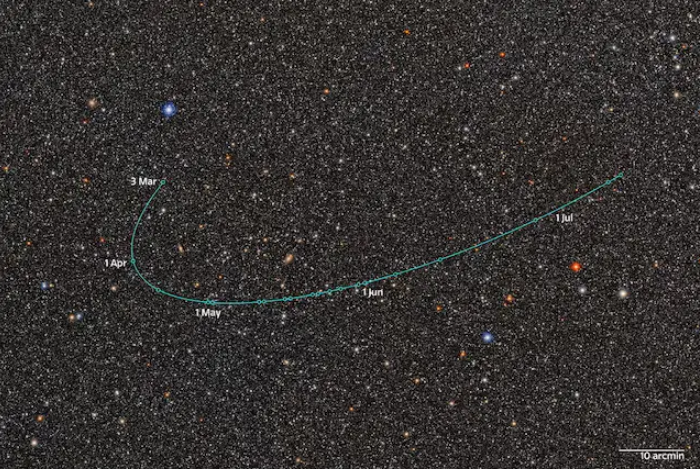
Astronomers have identified a distant icy object beyond Pluto that could become one of the few officially recognized dwarf planets in our solar system. The object, designated 2026 ED138, is estimated to measure between 600 and 1,500 kilometers in diameter and orbits the Sun at a distance far greater than Earth’s, making it a potentially important addition to the growing list of discoveries in the outer solar system.
The discovery was made using the Vera C. Rubin Observatory in Chile, a powerful astronomical facility designed to survey the sky and detect objects that might otherwise remain hidden in the vastness of space. According to Reuters, researchers believe the newly identified body could qualify as a dwarf planet, although additional observations will be needed before its classification can be confirmed.
The object known as 2026 ED138 is located in the outer solar system, a region populated by small, cold bodies that orbit the Sun at enormous distances from Earth. Researchers estimate that it travels approximately 46 times farther from the Sun than Earth does.
For comparison, Earth orbits the Sun at an average distance of approximately 150 million kilometers, a measurement astronomers call one astronomical unit. At 46 astronomical units, 2026 ED138 would be roughly 6.9 billion kilometers from the Sun, although its actual distance changes as it moves along its orbit.
Pluto, one of the best-known objects in this distant region, has an average orbital distance of approximately 39.5 astronomical units. This means that 2026 ED138 occupies a similarly remote part of the solar system, beyond the orbit of the former ninth planet.
However, its size alone does not establish whether it qualifies as a dwarf planet. Astronomers must determine more about its physical characteristics before reaching a definitive conclusion.
Why Its Size Matters
Objects in the outer solar system vary enormously in size, from relatively small chunks of ice and rock to worlds large enough for gravity to shape them into nearly spherical bodies.
The estimated dimensions of 2026 ED138 place it among the larger objects that researchers investigate when searching for potential dwarf planets. Nevertheless, the wide range in its estimated diameter highlights the uncertainty that can surround observations of distant bodies.
These objects receive very little sunlight compared with planets closer to the Sun. As a result, they can be difficult to study, particularly when they are small, faint and located against the background of distant stars.
What Makes an Object a Dwarf Planet?
The term dwarf planet refers to a specific category of celestial body. Under the definition adopted by the International Astronomical Union in 2006, an object must orbit the Sun, have sufficient mass for its own gravity to give it a nearly round shape, and not have cleared the neighborhood around its orbit of other objects.
The final condition distinguishes dwarf planets from the eight officially recognized planets, which dominate their orbital regions.
Pluto is the most famous example of a dwarf planet. It was classified as the solar system’s ninth planet for decades before the International Astronomical Union redefined the categories in 2006.
Other recognized dwarf planets include Ceres, located in the asteroid belt between Mars and Jupiter, as well as Haumea, Makemake and Eris, which occupy the distant outer solar system.
Although these bodies differ in size, composition and orbital characteristics, they help scientists understand how planetary systems develop and why some objects grow into major planets while others remain smaller.
Why Scientists Have Not Confirmed the Classification
For 2026 ED138, the central question is whether it possesses the physical characteristics required to qualify as a dwarf planet.
Its estimated diameter makes it an interesting candidate, but researchers must establish whether its gravity is strong enough to pull the object into a nearly spherical shape. Its orbital characteristics and other physical properties also need to be understood more clearly.
The available discovery information does not establish that these requirements have been met. Further observations will therefore be necessary before scientists can determine whether the object deserves formal recognition as a dwarf planet.
The Vera C. Rubin Observatory Opens a New Window on Space
The discovery of 2026 ED138 was made possible by the Vera C. Rubin Observatory, located on Cerro Pachón in central Chile.
The observatory is a joint initiative involving the U.S. National Science Foundation and the U.S. Department of Energy. It was designed to conduct an extensive survey of the sky, repeatedly imaging large areas to reveal objects that move, change brightness or appear in previously unobserved locations.
Its wide-field telescope and advanced camera are particularly valuable for studying populations of distant objects in the solar system. By comparing observations taken at different times, astronomers can identify faint bodies and calculate their movements against the background of stars.
This approach is important when searching for objects beyond Neptune, where even relatively large bodies can be difficult to detect because of their distance from Earth and the limited amount of sunlight they reflect.
Why Repeated Sky Surveys Matter
Rather than concentrating exclusively on a single planet or a small area of the sky, large astronomical surveys allow researchers to collect vast quantities of data over time.
This makes it possible to identify previously unknown asteroids, icy bodies and other objects whose movements reveal their positions and orbital paths.
As observations continue, researchers may also be able to refine estimates of the sizes and orbits of objects such as 2026 ED138, improving their understanding of where these bodies fit within the broader population of distant solar system objects.