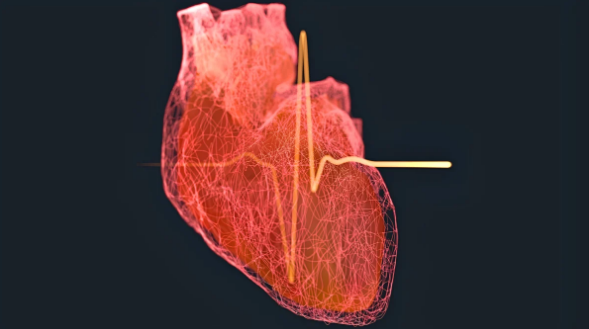
The human heart beats approximately 100,000 times a day, maintaining the continuous flow of blood that keeps the body functioning. When this activity suddenly stops, however, the consequences can be devastating.
More than 350,000 people in the United States experience sudden cardiac arrest every year, and most do not survive long enough to reach a hospital.
These deaths are generally classified as sudden cardiac death, which refers to an unexpected death caused by a heart-related problem, typically occurring within one hour of the onset of symptoms. Estimates suggest that the condition claims up to 300,000 American lives annually and may account for as much as 15 percent of deaths worldwide.
According to ScienceAlert, a new study published in the scientific journal Nature points to a potentially promising way of identifying people who face an elevated risk.
One of the ways doctors can protect people at risk of dangerous heart rhythm disturbances is through implantable cardioverter-defibrillators. These devices monitor the heart and can detect and correct potentially life-threatening electrical abnormalities before they become fatal.
However, deciding which patients should receive an implant remains a significant challenge.
“We have the solution to this problem,” says Ziad Obermeyer, a physician and artificial intelligence researcher at the University of California, Berkeley.
“If you knew you were one of the people at risk of dying suddenly, you would go to a cardiologist and have a defibrillator fitted. The problem is that doctors fail to determine who needs it before it’s too late,” he explains.
To investigate whether artificial intelligence could improve this process, Obermeyer and his colleagues developed a deep-learning model designed to recognize electrical patterns in the heart associated with an increased risk of sudden cardiac death.
The researchers trained the system using more than 440,000 electrocardiogram (ECG) recordings from Sweden. They subsequently tested its performance using data from nearly 140,000 patients in the United States, along with a smaller patient group in Taiwan.
An ECG is a relatively inexpensive, non-invasive examination that records the heart’s electrical activity through electrodes placed on the skin.
“Applying deep learning to ECG could offer the benefits of both approaches: a standardized, easily accessible, and low-cost recording that can be directly analyzed by an artificial intelligence system to predict risk, without the need for human intervention,” the researchers write in their paper.
The AI model identified patients at significantly higher risk
The findings revealed that the system could distinguish a group of patients facing an elevated likelihood of sudden cardiac death.
In the Swedish sample, the AI model classified 2.2 percent of participants as high-risk patients. Within one year, 7 percent of this group experienced sudden cardiac death.
The researchers compared these results with those obtained through a conventional medical assessment known as left ventricular ejection fraction (LVEF), which measures how effectively the heart’s left ventricle pumps blood.
Using this traditional method, doctors identified a high-risk group representing 1.9 percent of the sample. However, 4.6 percent of those patients experienced sudden cardiac death within a year.
An important difference emerged when the two approaches were compared: they identified relatively few of the same individuals.
The researchers found that the traditional LVEF assessment failed to identify 86.1 percent of the high-risk patients detected by artificial intelligence.
The findings also raised the possibility that some of these deaths could be prevented through earlier intervention.
Among high-risk patients identified by the AI system, those who already had implanted defibrillators experienced a 54.4 percent lower rate of sudden cardiac death than statistically expected.
However, the researchers cautioned that this was an observational finding. It does not establish that the implanted devices directly caused the reduction in deaths.
“In practice, high-risk patients appear to constitute a new, previously unidentified group in whom deaths are frequent and potentially preventable,” the study authors write.
Using a second artificial intelligence model to visualize the electrical patterns associated with high-risk patients, the team identified a feature of the ECG waveform that had not previously been described.
According to scientists, this feature, called a “slurred downstroke,” appears in the electrical waveform recordings of high-risk patients. It can be a sign of nearby heart problems and may be linked to fibrosis, the buildup of scar tissue in the heart muscle that can impede the normal conduction of electrical impulses.
Changxin Lai, a biomedical engineer at Johns Hopkins University who was not involved in the research but wrote a commentary about it, highlighted the broader scientific importance of the discovery.
“The fact that an approach based on machine learning can uncover a previously unknown pattern in such well-known data demonstrates that deep learning, when combined with other appropriate tools, can go beyond prediction and even contribute to scientific discoveries,” he wrote.
“ECGs have been interpreted by doctors for more than a century, but this study proves that even the most studied data may contain messages that have yet to be discovered.”