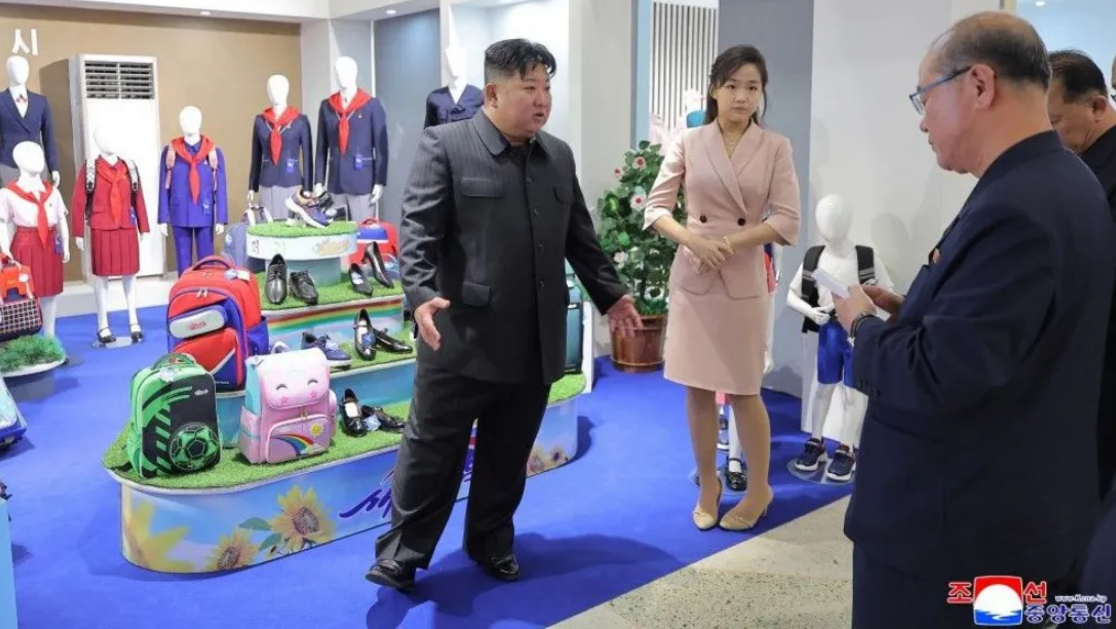
North Korean leader Kim Jong Un has appeared in state-controlled media following unverified claims circulating online that he had died from a cerebral hemorrhage. Images published by North Korea’s official media showed Kim attending a clothing exhibition alongside his daughter, Kim Ju Ae, and several senior associates, contradicting reports that had raised questions about his whereabouts.
The photographs were published by Rodong Sinmun, North Korea’s ruling party newspaper, according to the BBC. Their release came just hours after a Chinese dissident living in the United States claimed that Kim had died in a hospital in Beijing and that his body had been secretly returned to Pyongyang.
However, the allegation was not accompanied by verifiable evidence, and no independent confirmation was provided to support the claim. The appearance of Kim in state media shifted attention back to the difficulty of verifying information about the North Korean leader, whose personal life and health remain closely guarded by the country’s authorities.
Kim Jong Un Appears at a Clothing Exhibition
The images released by Rodong Sinmun showed Kim Jong Un visiting an exhibition dedicated to clothing, accompanied by his daughter and members of his inner circle. The photographs presented him participating in a public event, offering a visible response to the rumors that had spread shortly before their publication.
North Korean state media regularly publish photographs and reports documenting the leader’s official activities. These appearances are closely followed by international observers because access to reliable information from the country remains limited.
His Daughter Kim Ju Ae Appears Alongside Him
Kim Ju Ae’s presence at the exhibition was another notable detail in the published images. She has increasingly appeared beside her father at selected public events, drawing attention from foreign analysts and media organizations.
Her appearances have fueled discussion about the future of North Korea’s leadership, although the country has not publicly confirmed that she has been formally designated as Kim’s successor.
North Korea is governed through a highly centralized political system, and information about decisions within the ruling family is rarely made available to the public. As a result, even seemingly routine photographs can attract considerable international interest.
The exhibition itself provided an opportunity for state media to document Kim’s participation in an official engagement while also showing members of his family and senior officials accompanying him.
Unverified Claims Trigger Questions About Kim’s Health
The latest rumors emerged after a Chinese dissident based in the United States alleged that Kim had died in a Beijing hospital following a cerebral hemorrhage. The same individual claimed that his body had subsequently been returned to North Korea in secret.
The allegations quickly attracted attention because of the potential political consequences that the sudden death of the North Korean leader could have. However, the claims were not supported by publicly available evidence, and they should not be treated as established facts.
The publication of photographs showing Kim at an official event offered a direct visual response to the circulating reports. Nevertheless, images distributed by state media do not independently establish every detail of a public figure’s medical condition.
Why Information From North Korea Is Difficult to Verify
North Korea operates under strict controls over information, with state media playing a central role in communicating official announcements and documenting the activities of its leadership.
Foreign journalists have limited access to the country, while independent reporting from inside North Korea is difficult to obtain. This environment creates challenges for international news organizations attempting to verify claims about senior officials, particularly when those claims concern private matters such as health or unexpected political developments.
Rumors can spread rapidly in the absence of reliable information, especially when they involve a leader whose public appearances are closely monitored by foreign governments and analysts.
For this reason, claims about Kim Jong Un’s death or medical condition require careful examination and confirmation from credible, independent sources. Unverified statements circulating online should not be confused with confirmed news.
Why Kim Jong Un’s Health Attracts International Attention
Kim’s health has long been a subject of international interest because of his position at the center of North Korea’s political and military system. The country possesses nuclear weapons and maintains an extensive military establishment, making developments involving its leadership a matter of international security.
The uncertainty surrounding the leader’s health is also linked to the limited transparency of the political system. North Korean authorities do not routinely provide detailed public information about his medical history, and foreign observers often rely on official photographs, televised appearances and reports of scheduled activities to assess whether he has been seen in public.
Kim has previously attracted attention during periods when he was absent from public view. Such absences have prompted speculation, although the absence of a public appearance alone does not establish that a leader is seriously ill or that a major political change has taken place.
The Question of Political Succession
Another reason reports about Kim’s health attract attention is the question of who would lead North Korea if he were suddenly unable to govern.
The country’s political system is closely associated with the Kim family, which has ruled North Korea since its establishment under Kim Il Sung. Kim Jong Un succeeded his father, Kim Jong Il, after his death in 2011.
The future of that leadership structure remains a subject of international analysis. Kim Ju Ae’s increasing visibility has contributed to discussions about succession, but her public appearances alone are insufficient to establish what role she may hold in the future.
Any sudden change in leadership could raise questions about political stability, military decision-making and the direction of North Korea’s foreign relations. These possibilities help explain why unverified reports about Kim’s death can receive widespread attention even before credible evidence emerges.